Candidate Responses: 2026 South Milwaukee School Board

Election season has long been one of the most engaging times for readers of this blog. Candidate profiles, election updates, and opportunities to hear directly from the people seeking to represent our community have consistently drawn strong interest. When former Mayor Erik Brooks passed stewardship of this publication to Strong Towns South Milwaukee, he did so with the understanding that this tradition of helping neighbors stay informed—and connected to local civic life—would continue.

Last week, we took another step in that tradition by hosting our second Spring Candidate Forum at the library. More than 40 neighbors joined us for a thoughtful and energetic conversation about the future of our schools and community. Four candidates for the South Milwaukee School Board participated (in alphabetical order): Tory Elliot, Melissa Ellis, incumbent Brian Genduso, and John Nuck. Two additional candidates—incumbent Patrick Hintz and Terrence Talley—were also invited to the forum but were unable to attend.

We also invited candidates to submit written responses so voters could hear more about their perspectives. Again, four of the six candidates did so, and their responses are included below. We will add responses if we receive them from the missing candidates. Responses are in the candidates’ own words, and are presented in alphabetical order, rotated per question.

Election Day is Tuesday, April 7. Voters will see a full ballot this spring, including races for Wisconsin Supreme Court Justice, Court of Appeals Judge (District 1), several Milwaukee County Circuit Court branches, Milwaukee County Supervisor District 8, South Milwaukee Mayor, a special election for Municipal Judge, South Milwaukee School Board, and a municipal library referendum. The information below is intended to help voters learn more about the school board candidates before heading to the polls.

— Bryce Ulmer, Strong Towns South Milwaukee

Note: For the sake of transparency, Tory Elliot is one of the editors of this blog as well as an active member of Strong Towns South Milwaukee. She played no role in planning the Spring Candidates Forum or producing this blog content.


1. What does good school board governance look like?

Tory Elliot: I believe that a good school board governance is a school board that can work together, trust each other as colleagues, and also hold the superintendent accountable for the work that is within the strategic plan and based on the constituents needs. I believe in order to govern any body or system, the elected official needs to be connected and informed of the issues they are standing for. For me this means that an awareness of what it looks like and feels like within our district is important. School board members should be open to hear from stakeholders within the district. To me this means that I should be having intentional conversations with teachers, students, staff, etc, in order to ensure our goals set are being met. 

Melissa Ellis: Good school board governance involves school board members working as a team to set a district-wide vision, create and uphold policy, and to set goals to advance the district, while overseeing the superintendent, who manages day-to-day operations. Their job is ensuring student success and making sure that all children are prepared upon graduation for whatever direction life may take them whether it is college, the trades, the military, or other career paths.  This is done through staff retention, being fiscally responsible with taxpayer dollars, and building community trust. Members are the connection between educators, administration and the community that elected them. They also need to be open to actively listening to the educators, administration and the community members to gain all the data needed to make informed decisions.

Brian Genduso: Above all else, listening.  Listening to parents, listening to students, listening to teachers and staff and administration, listening to community members and other community leaders.  Listening to those you tend to agree with, and those you don’t.  Listening with empathy.  Taking in all perspectives in order to make the best decisions you can.

Second, being as prepared as possible for meetings and votes.  This means spending significant time reading, researching school policy and procedure, and reaching out to others who know more than you do on certain topics.  There is a ton to learn, and I can tell you with complete confidence that there is no possible way you can fully understand all the issues you will need to evaluate without first doing your homework.  In short, good board governance involves actively educating yourself.

Third, asking good questions.  Again, no one can expect a board member to be an authority on all school and community related subjects, some of which are quite complex or contentious.  Asking questions, sometimes hard or uncomfortable ones, is necessary to help truly understand the who, how and, most importantly, why.  Questions can reveal mistakes, oversights, or poor intentions.

Finally, staying focused on what matters most, and consistently working toward our common goals at every meeting.  I’ve found there are many opportunities to get sidetracked by insignificant details, or distracted by competing interests.  Focusing on student success and well-being is a necessity.

John Nuck: For me, good governance starts with listening. A strong board earns people’s trust by being open, respectful, and focused on what’s best for kids—not politics or personalities. It means making decisions in public, explaining the “why” behind them, and working together even when we don’t all agree. The board’s job isn’t to run the schools day to day—it’s to set clear goals, monitor progress, and hold ourselves accountable. When we communicate honestly, support our staff, and keep students at the center, good things follow.


2. Where do you see inequities in the district, and how should they be addressed? 

Melissa Ellis: An inequity I see in the district is that in every grade level we see a varying level of student performance. We have students that are performing at a very high level and those that are performing at a very low level. This puts strain on the educators in the classroom having to manage to teach curriculum to this vast difference in level by still maintaining interest of all students. We have seen the districts scores in math and reading decline. 

Another inequity that I have heard a lot about in discussions with numerous parents in the district is the care that is received by  our students who have health plans, 504 plans, or individual educational plans. This is caused by a lack of staffing, training on  dealing with plans or behaviors., and a lack of support from administration.  If what I am hearing is true, this not only affects the education of the student but also the other children in the classroom.  It leads to educator burnout and increased staff turnover because they are not feeling supported. I have heard about teachers leaving in the middle of the year leading to long term substitutes which affects how the curriculum is taught putting children behind. I have also heard about parents removing their children from the district leading to declining enrollment and a stain on the district’s reputation. 

Brian Genduso: The biggest inequity I see in our school district is how much support each student receives at home from their family.  Students in our care come from diverse living situations of varying levels of financial and social stability.  Some have had every basic need taken care of since birth.  Others are currently homeless.  Some encounter nothing but positive, caring adults in their lives.  Others are subject to difficult family dynamics that border on neglect.  Many experience support structures somewhere in between.  I’m not trying to be dramatic or alarmist, but we need to be realistic about what students are up against before they even walk through a school door.

To be fair, I don’t believe a school district is solely responsible for addressing the root causes of these inequities.  Our focus must remain on education, leaving that larger societal conversation to be debated elsewhere.  However, I do strongly believe in our district’s moral imperative, which charges us to “remove barriers and care for all students so they feel accepted and will learn without exception”.  This means that when kids are on our watch we must be extraordinarily intentional about meeting every student where they are, particularly those at high risk, and giving them every opportunity we can to succeed.

It’s a huge task. I think one way to accomplish our mission is to structure our schools to surround students with teams of teachers and staff who know them well enough to tailor an education and support system to remove barriers.  This could happen by making sure they are signed up for free or reduced cost meals to remove the barrier of hunger, or by connecting them with a guidance counselor to care for their mental health, or by providing them with targeted learning opportunities to strengthen the learning they may have missed at home, or by giving them outlets to foster meaningful relationships with peer groups so they feel accepted.  This requires coordinated planning and having systems in place, along with providing adequate staffing and a clear vision of our goals.   

John Nuck: Some kids have more advantages—access to technology, extra help at home, or after-school opportunities. Others face challenges that make it harder to keep up. We’ve got to recognize those differences and respond. That might mean more tutoring, mental health support, or family outreach in the places that need it most. Equity doesn’t mean treating everyone exactly the same—it means making sure every student gets what they need to succeed.

Tory Elliot: In South Milwaukee, we have a wide socioeconomic spread. We have some individuals who live in a very low socioeconomic status who struggle to have their needs met. I believe these are more noticeable within our elementary schools. Children cannot learn when they are coming into the classroom dysregulated due to a variety of reasons. Some classrooms are having to play a more social worker role in order to get children ready to learn. This takes up time in the classroom and takes away from the district’s abilities to reach standards. These students need resources, outside of the classroom, in order to have a truly equitable education. 


3. What unique skills, knowledge, and/or perspectives do you bring to this role? 

Brian Genduso: We have a slate of really excellent candidates for school board this year, so I don’t know if any of my skills or knowledge base are in and of themselves unique.  However, I do think I have a solid blend of strengths. I am:

  • Experienced Current board member (7 months)
    • Part owner of a local engineering firm (6 years)
    • Governing board member at my church (8 years)
  • Thorough
    • Detail-oriented
    • I do my homework and evaluate things from multiple angles
  • Reasonable
    • I am a structural engineer, seeking facts over opinions
    • Logical in my decision making
    • No agenda, just what is best for students and our community
  • Compassionate
    • I try to see myself in others
    • Believe in the great potential of students and staff
  • Accountable
    • Responsive to feedback
    • Not afraid to admit fault
    • Flexible, adapting to changing needs
    • Communicate well, semi-pro email writer 😉
  • Dedicated
    • Work hard
    • Invested in our kids as a coach, youth leader, and mentor

John Nuck: I bring a mix of real-world experience and community perspective. My time in corporate management taught me how to listen, solve problems, and make smart use of limited resources. I’ve also stayed involved in civic life because I really believe strong communities depend on communication and respect. I like to combine common sense with curiosity—ask questions, listen before acting, and focus on what helps people. That’s how I’d approach my work on the board.

Tory Elliot: I believe I carry a variety of unique perspectives to this role. For one, I grew up also in a lower socioeconomic status. I was an ‘okay’ student, but often did not have an ability to focus in school. I am the first person in my family to go to college, meaning I do believe in knowledge accessibility, especially with post-highschool learning paths. I am a mental health provider who has focused on the treatment of trauma. I have worked with a variety of different people who have had a variety of different experienced traumas. What motivated me to run for board was due to the perspectives of both teachers and students that I see in my office. I believe my personal and professional experiences serve the board’s position well. 

Melissa Ellis: One of the perspectives that I have that’s unique is that I have grown up here in South Milwaukee and was a product of this district. We were a school of excellence when I attended and my goal is to get us back to that level. I have knowledge about the history of the town as a third generation South Milwaukeean. 

I am a nurse and have a passion for helping others. As a nurse I regularly advocate for my patients care and as a board member would advocate for children’s education. I am a mother to a middle school student, so the decisions made at the board directly affect my family. 

I have experience working in government as a public health nurse for the City of South Milwaukee and have knowledge on how budget processes work. I know how government budgets work and that sometimes hard decisions need to be made. I have also been a member of a state advisory committee for emergency preparedness and have served on multiple commissions for the City of South Milwaukee. I have been a member of the civic grants committee and I was the chairperson of the 125th anniversary committee. I had to manage a budget, lead meetings and managed 6 events that honored this city’s history. This gives me perspective to understand how school board meetings are structured and operate. I understand Robert’s rules which are how these meetings are operated. 

I am also very familiar with state statutes and administrative codes.  I am extremely thorough and ask a lot of questions because I do not take making decisions lightly. I do research and need to have data. I do not jump into things or make emotional decisions. I make sure to look at both sides and all the options before making decisions. 


4. How should the district support both advanced learners and students who are struggling—academically or emotionally? 

John Nuck: Every student learns differently, so one-size-fits-all doesn’t work. Advanced learners need chances to go further—through advanced classes, creative projects, or enrichment programs. Struggling students need early, consistent support and adults who remind them they can do it. Academic help and emotional support go hand in hand, because confidence affects learning more than we sometimes realize. When kids feel supported and capable, the academics follow.

Tory Elliot: There needs to be spaces for both of these students. While there are resources for both exceptional learners and learners on IEP’s, there are no concrete spaces or experiences for those who may not qualify for an IEP but who are not doing well in classrooms. I believe there needs to be a physical space and plan to engage these types of learners so they are not left with the chronic sense of feeling behind or an inability to catch up. 

Melissa Ellis: I think that we need to be sure that we are looking at all children equitably. Those who need additional help should receive interventions whether it be academically or emotionally. Also those advance learners should be pushed to achieve bigger and better things. We need to make sure we are not relying on a single teacher in the classroom to do this on their own. I like the ideas that the middle school has come up with regarding targeted instruction for those who need the extra help and for those who don’t, the ability to take extra electives that advance their education. 

At the elementary level we need to give additional classroom support and form curriculum that can be advanced for those in the classroom but also be accessible to those that need additional intervention. Maybe this can be something like splitting up the teachers and having them do targeted instruction. Maybe even having some of the advance learners help with bringing partnering with the ones that that need more help to have them learn more skills.

Brian Genduso: Let’s start with those who are struggling emotionally.  Whether a student is an advanced learner or one who is academically behind, I believe the types of supports are the same.  First and foremost, the district needs a team of qualified, trained social workers and counselors in every school who can help identify social or emotional issues and intervene quickly before the situation worsens.  They can then either provide individual support in the form of guidance or counseling or sharing basic health and well-being strategies for the student, or they can connect the student and their family to more targeted outside resources such as mental health professionals or behavior specialists.  Like most public schools in this area, SDSM already has such a system of staff in place.  For many students, including one of my own children, this level of school-based emotional support works well.

For students who are struggling academically, surrounding them with a team of teachers and staff who can provided layered or scaffolded support makes a lot of sense.  The old proverb of “It takes a village” rings true.  If there are multiple adults who are responsible for supporting a student, it is less likely that a kid will fall through the cracks.  It is also easier to engage the student with targeted educational opportunities that meet them where they are, rather than a one-size fits all approach with a wing and a prayer.

As for advanced learners, I believe some of the same tools that can help a struggling student can help one that needs additional challenge or extension, but the methods will vary somewhat depending on grade level.  In elementary schools, advanced learners will benefit from enrichment opportunities that are initiated by their classroom teacher or district advanced learning coordinator.  In middle school they should be able to add extension activities directly in the classroom, similar to elementary, but also be allowed to take more advanced courses.  In high school, advanced learners will benefit most from having a variety of advanced-level, rigorous course offerings.  At each of the three stages, we need staff who can appropriately lead/teach.


5. What is the board’s role when parents disagree with curriculum or materials choices? 

Tory Elliot: The board’s role is policy and holding the superintendent accountable to enacting these policies. While parent feedback is important, I believe this should be addressed in collaboration with the teachers as well as supporting administration. 

Melissa Ellis: The boards role would be to take any and all complaints seriously and  review the complaint to understand what the issue with the curriculum is. According to the districts curriculum and instructional program development and evaluation policy #330, the role of the board is to review, revise, and adopt the Wisconsin state or national standards aligned with the content area. The work on developing and selecting curriculum is done through research by the superintendent, curriculum and instruction director, and the educators in charge of implementing the curriculum and associated resources. 

As a board member I would look to the superintendent and curriculum and instruction director to review the complaint and look to the Wisconsin and national standards to investigate if the curriculum is aligned or not. I would ask them to then bring that back to the board to review and make a formal response back to the complaint. 

Brian Genduso: I assume you mean the situation where a single parent or small group of families disagree with a curriculum or resource.  First, listen intently to the parent’s concern.  Second, when appropriate, ask clarifying questions of the parent to make sure the board is understanding the parent’s position and intent.  Third, take really good notes so their concerns are documented.  Fourth, recommend that the parent speak with the Director of Instruction and/or the Superintendent so they can gain better insight on why a particular curriculum is in place or a particular resource is being used.  Fifth, if/when the board has to make a decision on curricula or resources, take the parent’s perspective (and those of other parents or educators) into consideration.  Finally, the board must be prepared to clearly explain the reasoning behind its decision.

John Nuck: Parents care deeply about their kids’ education, and that’s a good thing. When disagreements come up, the board’s role is to listen respectfully, look at the facts, and be sure our materials meet educational standards. We also have to trust our teachers—they’re trained professionals who choose materials for a reason. Not everyone will agree on every topic, but the goal is to give students a well-rounded, accurate, and age-appropriate education that equips them for the real world.


6. What are your thoughts about the role of the school board in determining what books are kept in school libraries? 

Melissa Ellis: I think that the library at the school should have books that are age appropriate. I would look to the districts policies to see if the book aligns with the policy. If there is not a policy in place then I would look to the Wisconsin and national curriculum standards for guidance. If a parent thinks a book is inappropriate or has questions we would look to the librarian, teachers, the curriculum and instruction director to explain the reasoning behind the use of the text. If it didn’t align with these standards then I would look to the board to discuss and develop a policy.

If the text didn’t align with the standards then the book would need to be removed from the curriculum. If it did align with the curriculum I would ask the superintendent and curriculum and instruction director to meet with parents to explain the reasoning behind the use.

Brian Genduso: A school board’s primary duties are to set the shared vision and goals for the district through policy making, budgeting, and hiring and evaluating the Superintendent.  Legally, the school board has the authority to manage the property and affairs of the school district related to education, including providing programs and resources.  Therefore, the board has the ability and responsibility to oversee the library program and its content.  That being said, the board also has the authority to delegate such oversight to competent professionals such as a librarian and school administration.

Practically speaking, the board’s role is not to micromanage the day-to-day operations of the district.  The selection of which books are added to or removed from each school library should, in general, be left up to the librarian and/or the teachers at that school who can professionally evaluate the educational value of the literature or resources with regard to student needs.  If an issue arises where the inclusion or exclusion of a book requires additional input, the board can consult with school leadership, district administration, parents, or other invested parties to discuss the merits of the book in light of the district’s educational vision and goals.

John Nuck: Books open doors—for knowledge, empathy, and understanding. The board should set overall policy, but it makes sense for librarians and educators to decide which titles fit different grade levels. Not every book is right for every student, but our libraries should reflect a range of perspectives. Removing books because they make someone uncomfortable doesn’t help kids grow—and growth is what education is all about.

Tory Elliot: I believe the board’s role is again creating policies for our district to follow. If a superintendent or library or staff member is focusing on a change regarding materials, this should be discussed in collaboration with administration and while upholding the strategic plan and standards. 


7. What made you decide to run for an elected position? 

Brian Genduso: The immense fame and fortune, and a burning desire to deprive myself of sleep by scrutinizing school board policies and writing emails to administrators at 1:00 in the morning!

In all seriousness, and in 50 words or less, it’s because I care deeply about public education and strongly believe I have the skills, experience and drive to serve in leadership and help SDSM fulfill its moral imperative and commitment to “remove barriers and care for all students so they feel accepted and will learn without exception”.

John Nuck: I’ve lived here for 17 years and care deeply about this community. Education touches everything—our kids, our neighborhoods, our local pride. After spending time at board meetings and talking with parents and teachers, I felt ready to step up and be part of the solution. For me, this isn’t about politics or ambition—it’s about service. I want to strengthen trust and communication and help keep our focus on what’s best for students.

Tory Elliot: While I have three children in the district, my goal for running has always been due to what I see in my office. I am a trauma psychologist and I have gotten many educators and students on my caseload. Many times we are not able to address the trauma the individual is coming in with due to the work being focused on balancing their love for students, administrative expectations, children’s behaviors, as well as grading. Many of the educators that I know or have spoken to are experiencing difficulties participating in self care therefore they experience burn out. I am running because I believe that the health of the teacher impacts our students and ultimately our community. 

Melissa Ellis: I had been thinking about getting more involved with my community for some time. Then this year seeing our districts educational scores continue to decrease I wanted to do more to influence change. I was seeing continuous turnover of teachers and had my own issues with my student having multiple teachers in a semester. In speaking with other parents I realized that this is happening more frequently than I knew. 

If you want to see change you need to be the change and so I decided that this meant being more involved and made the decision to run for school board. 

I also saw how some of the current board was rushing through the rec center process. I realized during that process that we need a voice on the board who is going to think about all members of the community from the students in the classroom, to the families that live here, and the seniors that continue to support the community.  

The scores directly affect property values because families look to this to make decisions about schools to determine if they want to live in the city. If our scores are bad it will decrease property values and families will move out leading to a decline in enrollment. I want to build our community back up and make sure it is a successful place and to make successful life like my husband and me did here in south Milwaukee.


8. What priorities would guide your decisions when allocating limited funds? 

John Nuck: Budgets are always about choices, so my first question would be: how does this help students? That means putting resources into great teaching, safe schools, and the staff who make learning happen every day. I’m a big believer in transparency, data, and getting the most value for every dollar. Supporting teachers and keeping technology up to date both pay off long term—but so does making sure each student feels seen and supported. Students should always come first.

Tory Elliot: My priorities will always be the health and wellness of students. When prioritizing decisions allocating funds, I would like to evaluate and be provided evidence from the stakeholders (i.e., students, teachers, and administrators) that these are funds that are going to meaningful decisions. I am aware that the school board runs ACT 80 (community recreation), when allocating funds for this program, I’d like to hear from community members when making decisions when possible. 

Melissa Ellis: I would have to look at all the things we are funding and look at where we can adjust things without affecting the education that is being provided.

Number one priority is the education of our youth and that should always be our first and foremost priority. 

I would also look to neighboring districts to see if there were ways to combine some services and reduce duplications. I think we need to review the budget to see where we can find efficiencies. Once that is complete then we need to focus on the people who are doing the hardest job of educating our children and make sure that we are retaining talented educators and staff members. Sometimes we will need to make tough decisions but the biggest piece is being transparent to the community and explaining what is happening on a regular basis so they have buy in to support our schools. I would try everything to not raise taxes and still maintain services. If we did need to raise taxes it would be a last resort and I would be transparent to the community who would be impacted. If we needed to do a large increase we would need to get community input through a referendum and hopefully through transparency they would understand what is needed and be able to make a decision.

Brian Genduso: Academic/career achievement and student opportunity are priority number one.  In other words, asking ourselves “Will this expense result in student success?”  Number two is teacher and staff support, primarily in the form of fair compensation but also by providing them with the resources they need to effectively do their job.  Number three is facility stewardship.  Board members are entrusted with incredible community land and building assets and need to make sure they stay safe, clean and functional for decades to come.

As a broader goal, within each of these priority areas my guiding principle would be to find the highest value possible.  This means not always going with the lowest cost, as cheapest doesn’t guarantee the best return on investment.  Likewise, the most expensive option doesn’t mean it will outperform something more economical.

Leave a comment

Filed under 2026 Elections, South Milwaukee

Three Ways to Plug into the Community this Weekend

Looking for a few ways to get out and connect with neighbors this week? Here are three great opportunities.

Thursday, March 12 — Spring Candidate Forum at the Library

Head to the South Milwaukee Public Library for a locally-organized, non-partisan Spring Candidate Forum from 5–6:45 p.m. It’s a chance to meet and hear directly from the neighbors running for school district, dig into the library referendum, and learn more about the issues shaping South Milwaukee’s future.

Local elections matter, and forums like this help keep our community informed and engaged.

Saturday, March 14 — Moran’s St. Patrick’s Block Party & Fun Run

Moran’s Pub is hosting a St. Patrick’s Fun Run with support from the South Milwaukee Running Club, Lakeview Coaching, Milwaukee County Parks, Friends of Grant Park and Strong Towns South Milwaukee. The 2.4-mile route through Grant Park starts at 3p.m. and returns to Moran’s just in time for their annual St. Patrick’s block party.

After the run, the street fills up with live music, food trucks, Irish dancers, and plenty of festive energy—making it a fun way to spend a Saturday afternoon with friends and neighbors.

Register here!

Sunday, March 15 — Library Trivia Tournament Kickoff

Also at Moran’s Pub, the first round of a four-week trivia tournament kicks off Sunday from 2–5 p.m. The event supports the South Milwaukee Public Library referendum, making it a fun way to test your knowledge while supporting a vital community resource.

Leave a comment

Filed under Events

Regional Issues Require Regional Solutions

Tonight, the South Milwaukee Common Council will hear a presentation from Milwaukee County on its Future State Project —a comprehensive review of how the County delivers services, funds priorities, and plans for long-term stability.

For South Milwaukee residents, this isn’t abstract policy. It’s about the buses we rely on, the parks our families use, and whether the County’s financial structure actually works for communities like ours.


This Matters Here at Home

Sitting on the edge of Milwaukee County, South Milwaukee is close enough to feel regional pressures, but far enough to sometimes feel overlooked. Many of our residents commute to jobs across the county. Families use county parks, the lakefront, trails, and the zoo. We pay county taxes. And when County finances struggle, we feel it.

The Future State Project asks a fundamental question: Is the current structure of County government built to serve today’s needs—or yesterday’s?

Two proposals in particular deserve attention from South Milwaukee residents: a Regional Transit Authority and a dedicated Parks & Zoo District.


Regional Transit

If you live here, you know transportation is regional.

Workers commute north to Bay View, downtown Milwaukee, and beyond. Others travel west to industrial parks and suburban job centers. Students, seniors, and residents without reliable cars depend on transit connections that are often infrequent or indirect.

Milwaukee County Transit System (MCTS) has faced years of financial strain. Funding instability has meant service reductions, longer wait times, and higher fares. When routes are cut or frequencies reduced, South Milwaukee residents feel it—especially those working second or third shifts.

Regional Transit Authority (RTA), currently prohibited under state law, would create a coordinated, stable funding structure across southeastern Wisconsin. The Milwaukee–Waukesha–West Allis metropolitan area (approx. 1.57 million residents) is widely considered one of the largest U.S. metropolitan areas without a comprehensive Regional Transit Authority. Instead of piecing together transit funding year-to-year, a regional model could:

  • Improve connections between South Milwaukee and major job centers
  • Increase service reliability and frequency
  • Strengthen eligibility for federal and state transportation dollars
  • Support long-term planning instead of crisis management
  • Build upon regional commuter rail options

Transit is economic infrastructure. When people can reliably get to work, employers can reliably hire. That benefits South Milwaukee businesses and families alike.


Parks & the Zoo

South Milwaukee residents treasure green space—from our own Grant Park and lakefront access to county-wide destinations.

Milwaukee County Parks and the Milwaukee County Zoo are not luxuries. They are public health infrastructure. They provide gathering spaces, environmental stewardship, recreation, and education.

But for years, these systems have been underfunded. Deferred maintenance has grown. Facilities age. Trails and roads crumble. Staffing levels remain stretched. Because parks funding comes from the County’s general budget, they compete annually with other essential services.

Parks & Zoo District would establish a dedicated funding source with its own levy, allowing:

  • Stable operating funds
  • Faster repairs to aging infrastructure
  • Bonding authority to tackle long-standing maintenance backlogs
  • Reduced pressure on the County’s general fund

For South Milwaukee families who use county parks, pools, trails, and the zoo, this would mean better-maintained spaces and more predictable long-term stewardship.


County Stability Affects South Milwaukee

Milwaukee County’s structural budget challenges don’t stay confined to downtown. When the County struggles, municipalities like South Milwaukee feel ripple effects—whether through service changes, shared costs, or reduced investment.

The Future State Project is about long-term sustainability. It is about building structures that support:

  • Financial stability
  • Equity across communities
  • Reliable services residents depend on

Tonight’s presentation is an opportunity for South Milwaukee elected officials to ask thoughtful questions:

  • How will these proposals impact our taxpayers?
  • How will they improve service reliability?
  • What safeguards ensure accountability and transparency?
  • How can South Milwaukee help shape regional solutions rather than react to them?

South Milwaukee is part of Milwaukee County’s future. Decisions made at the County level affect how we move, where we gather, and how we invest in shared assets.

The Future State Project is not the final word—it is intended to be the beginning of a broader public discussion. As draft recommendations move forward, community feedback will shape what ultimately reaches the County Board.

If we care about mobility, parks, fiscal responsibility, and regional cooperation, this is the moment to engage.

Regional problems require regional solutions—and South Milwaukee deserves a seat at that table.

1 Comment

Filed under City Council, Community, Milwaukee County, Strong Towns South Milwaukee, Viewpoints

What Proposed Changes for Bay View’s Kinnickinnic Ave. Can Teach Us About Building Stronger Streets

The newly released plans for Kinnickinnic Avenue in Bay View aren’t just a redesign. They’re a statement about what kind of places we want to build here in Milwaukee County.

At the center of the conversation is a familiar tension: is traffic calming anti-driver?

No. It’s simply pro-place.

When we design streets at a human scale, we don’t eliminate driving. We just appropriately balance it with the needs of everyone else who uses the corridor: kids walking to school, seniors crossing for groceries, families biking to the park, customers stopping at small businesses. Streets are public spaces first, transportation corridors second.

Here’s what that shift looks like and why it matters.

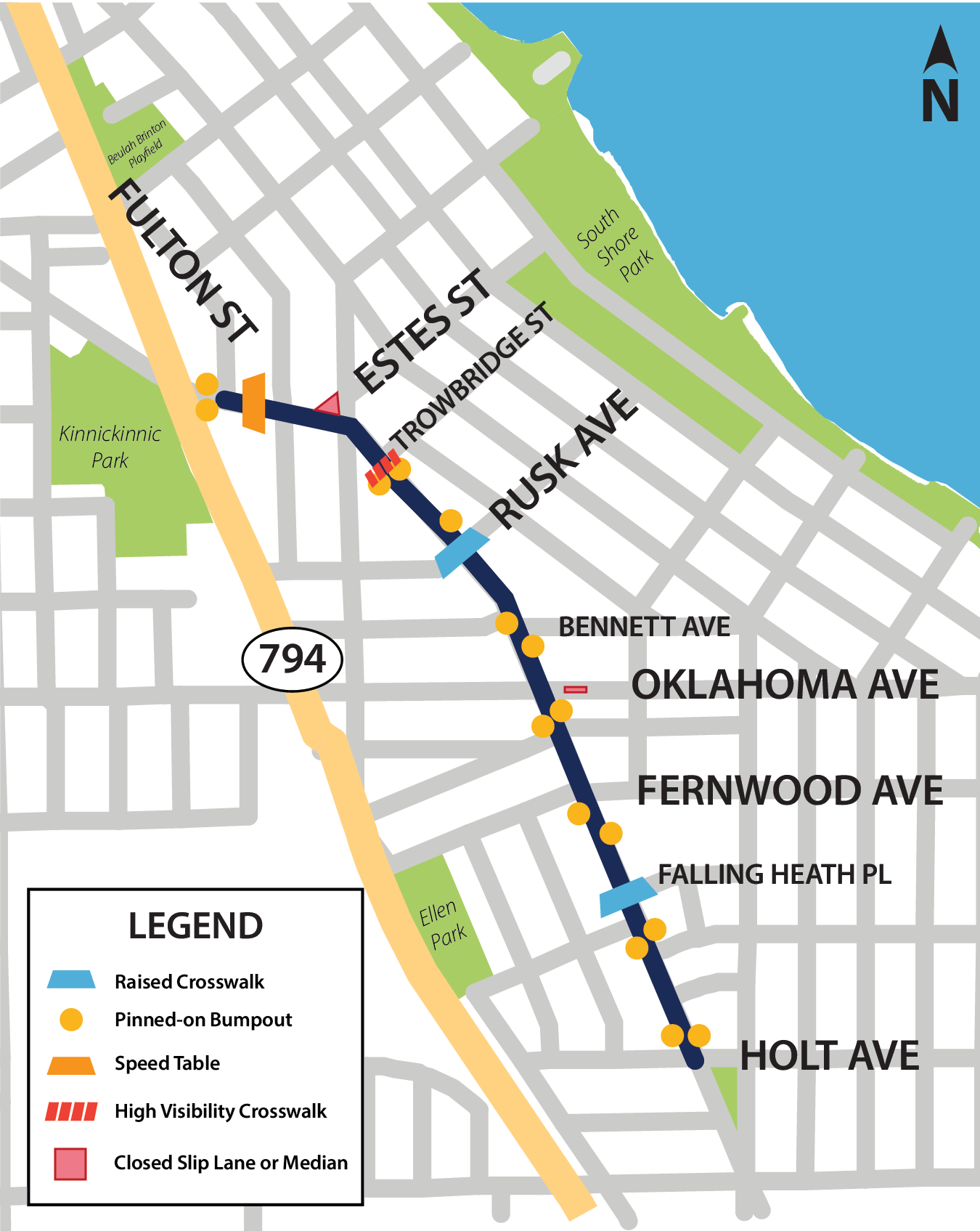
schematic of KK Ave. preliminary Jan 2026 design

Human-Scaled Benefits

A human-scaled street feels intuitive. It communicates, through design, that this is a place where people belong. When lanes are narrower, crossings are shorter, and speeds are moderated, something subtle happens: drivers pay more attention. Pedestrians feel seen. Businesses feel more accessible.

Instead of a corridor that people rush through a place, you get a street people spend time (and money) on.

That matters because comfort determines behavior. If crossing the street feels risky, fewer people will walk. If biking feels stressful, fewer families ride. If a parent doesn’t trust the intersection near a school, they drive instead—adding more congestion to the very street we’re trying to “speed up.”

Human-scaled design reduces that friction.


Economic Benefits

Commercial streets are economic engines. But high speeds and highway-style geometry undermine their productivity.

When vehicles move fast, drivers are less likely to notice storefronts, less likely to stop spontaneously, and more likely to treat the corridor as a pass-through route. Slower, steadier traffic increases visibility and access. It also reduces crash severity, which protects property, and reduces long-term public costs.

Small businesses thrive in environments where:

  • People feel safe walking between shops.
  • Parking maneuvers aren’t stressful.
  • Outdoor seating doesn’t feel exposed to speeding traffic.
  • Families linger instead of hurry.

Across the country, communities that retrofit overly wide corridors into people-centered streets see increases in foot traffic and commercial vitality. It’s about designing for productive land use.


School Zone Safety

Traffic calming becomes especially important near schools. Schools like Bay View’s Fernwood Elementary and Trowbridge School of Great Lake Studies which fall along KK Ave.

Children judge speed and distance differently than adults. They’re smaller, less visible over parked cars, and more likely to act unpredictably. A street that feels “fine” to a confident adult can feel overwhelming and dangerous to a child.

When we redesign streets near schools with raised crossings, tighter corners, and clearer pedestrian space, we send a message: this is a place where kids come first.

Safer school zones don’t just reduce crashes. They:

  • Encourage active transportation—walking and biking.
  • Reduce chaotic drop-off traffic.
  • Build independence for young people.
  • Lower stress for parents.

A community that protects its youngest residents builds trust. This is a lesson we should internalize here in South Milwaukee.


How These Specific Interventions Work

The tools proposed for Kinnickinnic Avenue are proven, practical, and increasingly common. They’re backed by science and best practices. Here’s what each one does:

Raised Crosswalks

A raised crosswalk elevates the crossing to sidewalk level. Drivers must slow as they approach, because the roadway physically rises.

Why they work:

  • Forces lower vehicle speeds at conflict points.
  • Improves pedestrian visibility.
  • Signals clearly that people crossing have priority; ensuring compliance with yielding laws.
  • Enhances accessibility for people using mobility devices by creating a flush crossing surface.

Bumpouts (Curb Extensions)

Bumpouts extend the sidewalk into the parking lane at intersections or mid-block crossings. Shorter crossings mean less time exposed in the street; especially important for seniors and children.

Why they work:

  • Shorten pedestrian crossing distance.
  • Improve sightlines between drivers and pedestrians.
  • Prevent dangerous parking too close to intersections.
  • Calm turning speeds by tightening corner radii.

Speed Tables

Speed tables are long, gently sloped raised sections of roadway. They are flatter and broader than traditional speed humps.

Why they work:

  • Reduce mid-block speeding.
  • Maintain smoother ride quality than abrupt humps.
  • Encourage consistent, steady speeds rather than fast acceleration between signals.
  • Improve comfort for buses and emergency vehicles compared to sharper devices.

High-Visibility Crosswalks

These use bold striping patterns instead of thin parallel lines. Visibility affects driver behavior. Clear markings reduce ambiguity.

Why they work:

  • Increase recognition at greater distances.
  • Improve nighttime and wet-weather visibility.
  • Reinforce pedestrian priority at intersections.

Closing Slip Lanes

Slip lanes allow right-turning drivers to bypass intersections without fully stopping. Closing them reclaims space for pedestrians and simplifies intersections.

Why it works:

  • Eliminates high-speed turning conflicts.
  • Reduces pedestrian exposure to multiple crossing points.
  • Makes intersections easier to navigate for everyone.
  • Reclaims space for public use, landscaping, or bike infrastructure.

Lessons to Learn

  1. Design communicates values. If a street feels like a highway, people will drive it like one.
  2. Speed is the key variable. Lower speeds dramatically reduce crash severity.
  3. Safety and prosperity are linked. Productive corridors depend on comfort and access.
  4. Small changes compound. Together traffic calming interventions reshape driver behavior.

The conversation around Kinnickinnic Avenue isn’t just about Bay View. It’s about what kind of streets we want throughout Milwaukee County, including our South Milwaukee home.

We can build corridors that move cars quickly. Or we can build places where people want to be.

The strongest towns choose the latter and design accordingly.

Leave a comment

Filed under South Milwaukee, Strong Towns South Milwaukee, Viewpoints

The Best Thing About Spring? Watching a Community Rally Around Its Library

There’s something about the stretch from late winter into spring that makes people want to do something. Maybe it’s the longer daylight. Maybe it’s cabin fever finally breaking. But right now in South Milwaukee, that restless energy is turning into something genuinely beautiful: a grassroots movement to restore funding to our public library.

On April 7, South Milwaukee voters will decide on a referendum to increase the library’s property tax levy by $425,000 — reversing nearly 20% in budget cuts the library has absorbed since 2019. For the average homeowner, we’re talking about $5 a month. For the community, we’re talking about a transformation.

And what’s been remarkable isn’t just the referendum itself. It’s how people have shown up.

This Didn’t Start When the Snow Melted

Long before yard signs went up or trivia nights got booked, a group of South Milwaukee residents was meeting in the dead of winter — bundled up, caffeinated, and committed — to build a campaign from nothing.

They designed the buttons. They laid out the flyers and bookmarks. They debated colors and copy and how to fit everything that matters about a library onto a palm-sized card. They mapped out fundraising ideas, planned events, coordinated schedules. And in between the organized work, they did something just as important: they sat across from their neighbors over coffee and kitchen tables and had real conversations about what the library means to this city.

No consultants. No playbook. Just people who care about this place putting in the hours when it would’ve been easier to stay home and wait for spring.

That’s worth noticing. Because by the time most people see a yard sign or hear about a trivia night, months of quiet, unglamorous work have already happened in the background. The campaign you see today was built in February living rooms and January group chats.

What a Yes Vote Actually Means

The South Milwaukee Public Library is already doing extraordinary work with limited resources — weekly fitness classes like Barre, Tai Chi, and Yoga; Friday movie screenings; teen programs like Creative Chaos and NERF nights; craft sessions; cultural celebrations; and technology workshops. All of this from a building that’s currently open just 44 hours a week.

A yes vote on April 7 would expand those hours to 54 per week, bring on additional staff, and grow the programming that makes the library one of the most vibrant spaces in town. More children’s programming. More summer reading. More of the community infrastructure that quietly raises property values, supports workforce development, and gives every resident — regardless of age or income — a place to learn, connect, and belong.

The Signs Are Everywhere (Literally)

Walk around South Milwaukee right now and you can feel the momentum building. Yard signs are popping up across town. Supporters are wearing buttons. What started as a handful of concerned residents has become something you can actually see in the neighborhood — a visible, growing declaration that this community values its library.

And the effort is only picking up speed. On Friday, February 28 at noon, volunteers are gathering at the library for the first canvassing day. No experience needed. Just show up, grab some materials, and spend an afternoon knocking on doors and talking to your neighbors about why this vote matters. It’s one of the most direct, effective things you can do — and it’s a great excuse to get outside as the weather starts to turn.

A Pub, a Tournament, and a Whole Lot of Heart

Then in March, the fun really kicks in.

Moran’s Pub — a South Milwaukee institution on Milwaukee Ave since 1995 — is hosting a 4-Week Trivia Tournament to support the referendum effort. Every Sunday from March 15 through April 5, from 2 to 5 PM, teams can compete across four themed rounds:

  • March 15 — Music Trivia: Artists, albums, lyrics, music history. Bring your playlist knowledge.
  • March 22 — Sports Trivia: It’s March Madness season. Basketball, local sports, and general athletics.
  • March 29 — Movie Trivia: Oscars season deep cuts. Film history, actors, directors, awards.
  • April 5 — Family Trivia: Disney and family-friendly entertainment. All ages welcome — a perfect way to close out the series two days before the vote.

There are weekly winners, a grand prize for the overall tournament champion, a 50/50 raffle, and Moran’s is donating 15% of food sales during each event. So yes, you can support your library by eating pub food and arguing about who sang what in 1987. Democracy is beautiful.

This Is What Community Looks Like

The campaign behind the referendum is entirely grassroots — unaffiliated residents working through the Friends of the South Milwaukee Library, a registered 501(c)(3). No political machine. No outside money. Just neighbors who believe a well-funded library makes everything else in town work a little better.

Yard signs are going up in front yards. Buttons are on jacket lapels. A local pub is turning Sunday afternoons into a four-week celebration of knowledge and community investment. And behind all of it, a team of volunteers who started this work in the coldest months of the year because they didn’t want to wait for someone else to do it.

It’s the kind of thing that reminds you why small cities like South Milwaukee are worth fighting for. Not because they’re perfect, but because when something matters, people actually show up. They knock on doors. They make flyers. They host trivia nights at a pub and donate the food sales.

How to Get Involved

  • Canvass on February 28. Meet at the library at noon. Help spread the word door to door.
  • Grab a yard sign or a button. Show your support and help build visible momentum across town.
  • Show up to trivia. Moran’s Pub, 912 Milwaukee Ave, Sundays starting March 15, 2-5 PM.
  • Vote April 7. Check your registration at myvote.wi.gov. Early voting begins March 24; absentee ballot deadline is April 2.
  • Donate. The Friends of the South Milwaukee Library accept contributions via Venmo — include “Referendum Support” in the memo.
  • Spread the word. Talk to your neighbors. Share the info. Sometimes the most powerful thing you can do is just tell someone this vote is happening.

Spring Is Here. So Is Your Chance.

There’s a version of South Milwaukee where the library has the funding it needs — where it’s open when people need it, staffed to serve everyone, and bursting with programs for kids, teens, and adults. That version is one vote away.

The best thing about this spring isn’t the weather. It’s watching a community decide, together, that their library is worth it.

See you at canvassing. See you at trivia. See you at the polls.

This is a referendum update written by volunteer Tyler Colby and is being shared from the South Milwaukee Public Library Referendum Supporters webpage with permission. The South Milwaukee Library referendum campaign is organized by residents working through the Friends of the South Milwaukee Library, a 501(c)(3) nonprofit. For more information, visit smplreferendum.com or the city’s official referendum page.

Leave a comment

Filed under South Milwaukee

Civic Pride Doesn’t Have to be Serious (or Divisive)

Just for fun, I tried to turn civic pride into a game. 😄

As a committed and concerned community member (…and Strong Towns South Milwaukee member), I spend an inordinate amount of time reading, researching and talking about (sometimes) contentious municipal topics—things like infrastructure, budgets, zoning changes, school board proposals, our library, and long-term comprehensive planning. All incredibly important stuff! But sometimes civic life can start to feel… heavy. 

I wanted to remind myself—and our neighbors—that loving this city can be simple, joyful, and even a little silly.

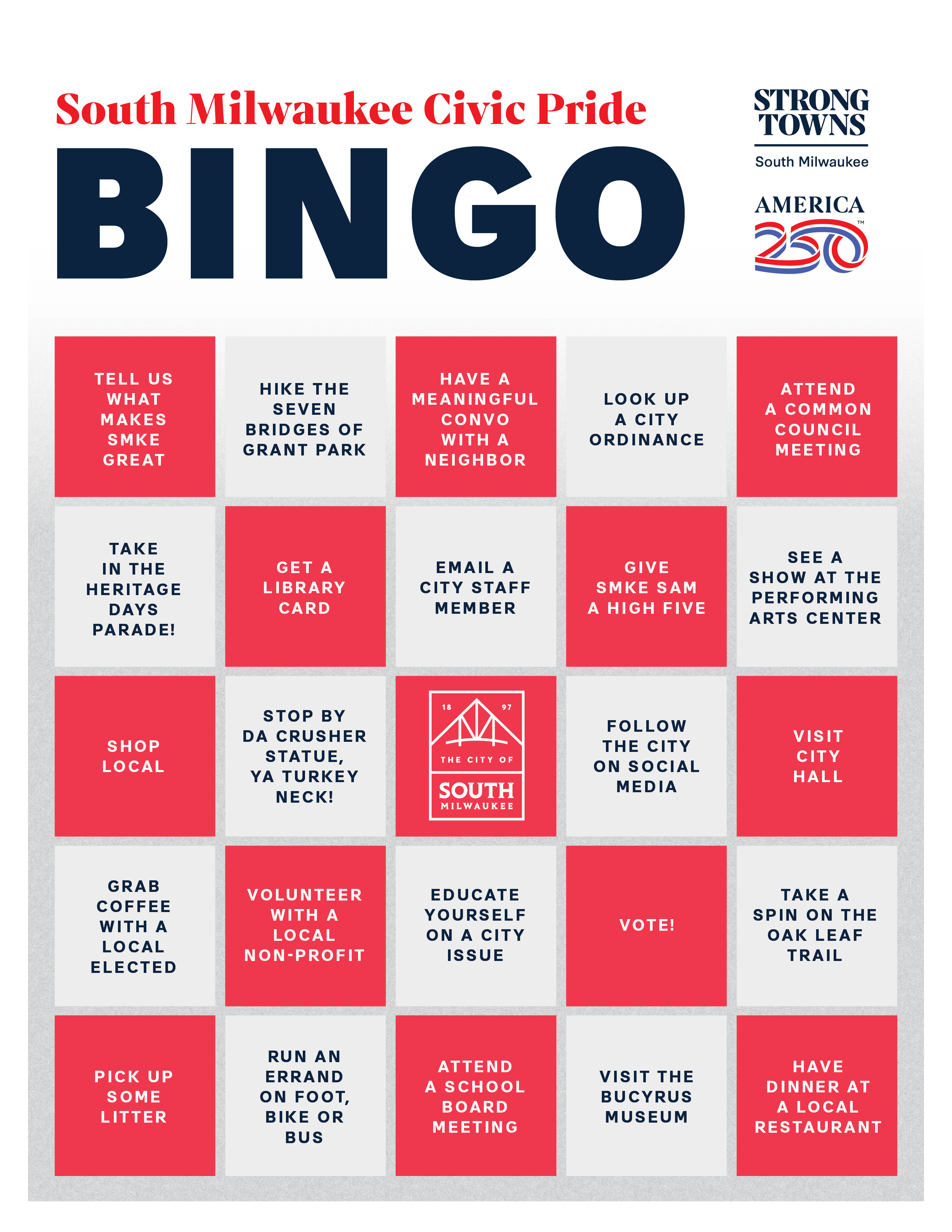
Introducing South Milwaukee Civic Pride Bingo—because civic pride doesn’t have to be serious to be meaningful. No prizes, no pressure, just a fun excuse to explore the city, support local, and appreciate the everyday stuff that makes South Milwaukee feel like home.

A bingo game card

Meetings, debates, campaigns, referendums, arguments on social media, “us vs. them” conversations about politics and priorities. It’s easy for people to feel burned out, disconnected, or like civic engagement is only for policy wonks and activists.

Civic pride doesn’t always have to look like a town hall meeting or a heated comment thread. Sometimes it looks like grabbing a massive cookie from Bakehouse 23, finding a segment of Oak Leaf Trail you never knew existed, attending a community event with friends, or stopping to admire a mural downtown you’ve driven (or biked…) past a hundred times. Those everyday experiences are civic life, too.

I know so many of us really, really love this place. Like, bigger love than South Milwaukee Sam love.

We love South Milwaukee not because it’s perfect, but because it’s ours. Because of the people who show up, the institutions that quietly hold things together, and the small moments that make it feel like home.

That’s the spirit behind Civic Pride Bingo. It’s not about being right, or winning arguments, or proving how engaged you are. It’s about reconnecting with the places and people that make up our shared community, in a way that feels accessible and fun instead of intimidating or divisive.

As we head toward America 250 this July, I hope we’ll have many national conversations about what it means to be part of a country, a democracy, a civic culture. But I think the best place to start is local. Civic pride isn’t built in faraway places—it’s built on our sidewalks, in our library, in our parks, on our beaches,, in our small businesses, and in the conversations we have with our neighbors.

My hope is simple: that this little Bingo game sparks a little more curiosity, a little more joy, and a little more love for South Milwaukee. Because strong towns aren’t just built with plans and policies—they’re built with people who care. And caring, it turns out, doesn’t have to be so serious all the time.

Leave a comment

Filed under South Milwaukee, Strong Towns South Milwaukee, Viewpoints

The student walk out

There was a lot to say about the walk out that occurred on Friday January 30th as many other schools were doing the same. Some community members were in support, as reflected in the post below, and some community members were outraged. I wanted to hear the perspective of the students who were organizing the protest. Below is the response:

“When the idea for a walkout protesting ICE first came about, I was all the way across the country in Ithaca, New York, flying back from a college audition. My flight had already been delayed by a day and a half, and I was desperate to get home. Then my good friend and fellow student activist, Miles, texted me—and I immediately knew this week was going to be insane.

Make no mistake: I am a rule follower above all else. I am a straight-A student (except for freshman-year accelerated biology—my only B+, which I still think about all the time), and I have literally never been grounded. I hate disappointing people more than anything, so the idea of organizing a walkout terrified me. I didn’t want to do something that could end up on my permanent record. As those fears built, I thought back to AP Government and Politics, where we learned about the First Amendment.

Freedom of speech applies to all people, regardless of age.

That is a sentence I repeated close to a hundred times this past week when peers came to me afraid of possible repercussions for walking out. Let it be known: I went about this the right way. I met with the principal and superintendent on Wednesday morning, two days before the protest, and emailed the chief of police that night to inform him of our exact route and timing. I created a group chat with the main student organizers and made sure everyone felt heard and respected.

I know many people will believe what they want to believe about our protest, but I want to clear a few things up. No, teachers did not organize it—the entire event was student-led. No, we did not “force” anyone to participate. Over 600 high school students chose not to walk out, and they are not being judged for that. And my personal favorite: no, I am not a “groomer” or a “pedophile.” I turned eighteen in November, I am still in high school, and I believe my supporters can speak to my character.

I was shocked by the level of support our protest received. A group of mothers followed us the entire way, providing hot chocolate, water, snacks, blankets, and hand warmers, all supplied through collected donations. Community members marched alongside us. A local church opened its doors as snow poured down so students could warm up and use the bathroom. Middle schoolers bravely joined us. We were covered by two news stations, Telemundo and TMJ4. In the days leading up to the walkout, people asked how many students I expected to attend. I usually said 50—and even that felt like wishful thinking. I would have marched even if it were just a small group of my theater friends. Imagine my surprise when the count exceeded 300.

The most common belief among those who opposed our walkout was that we “didn’t know what we were talking about,” which I find to be the weakest argument of all. We knew exactly what we were protesting. We were calling for an end to ICE’s reign of terror. Just because past generations may have felt disconnected from politics as teenagers does not give them the right to insult our intelligence. In an era where nearly every teen has a phone and social media, we are more informed and connected than ever. We see what is happening, and we have the right to speak out.

We left school at 12:30 p.m. on Friday, January 30, and met outside the tennis courts on 15th Avenue. Before we began, I laid out several ground rules using a megaphone:

  1. Stay on the sidewalk
  2. No swearing, middle fingers, or inappropriate behavior—we are peaceful
  3. Be respectful to all community members, whether they support us or not
  4. If you are dangerously cold, let someone know immediately

Once the march began, we walked along the parkway next to the high school, turned onto Oak Street, and then headed down North Chicago Avenue. Our destination was the corner of North Chicago and Pine, where we spread out along every visible stretch of sidewalk.

The protest lasted about two hours, until the school day ended. We chanted and held signs in 15-degree weather. At one point, the snow fell so hard that my once-multicolored scarf turned completely white. Still, I barely felt the cold. How could I, when the energy was so electric?

Our student organizers felt the same. “It felt very inspiring and uniting to see so many of my peers from such different walks of life coming together for this cause,” said Suzy, a junior.

Miles, who came up with the idea at 10:20 a.m. on Monday morning, expected “nobody but a few close friends to participate.” He shared, “It felt like, for the first time in my life, I truly had a voice.”

Addyson, a freshman, loved walking with a group of students “who shared the same passions and beliefs.” She said, “We advocated for the rights of human beings while staying genuine.”

As students, we are often told that we have a voice—only to be dismissed when we actually use it. I am not claiming that, at eighteen, I know more than someone with sixty years of life experience. But I do know something. In this case, I knew that what ICE is doing in Minneapolis and across the United States is wrong.

We were speaking up for our neighbors, our friends, and our families. We were speaking up for people across the country who may have come here illegally, but who still deserve a path to citizenship. We were speaking up for human beings.

Immigrants are not aliens. They are not “illegals.” They are not animals. They are people—human beings, just like everyone else. They do not deserve hatred fueled by blatant racism.

That is why we marched.

And for once, we were heard.”

Written by Shelby Brooks- one of the organizers of the walkout

4 Comments

Filed under South Milwaukee

Real change is coming to 12th Ave. & Milwaukee Ave.

On Tuesday night, the city’s Public Works & Public Property Committee approved six-month, interim safety improvements at one of South Milwaukee’s most challenging intersections—12th Ave and Milwaukee Ave.

The approved changes include removing the first on-street parking space closest to the intersection to improve sightlines, adding a high-visibility stop sign on the northwest corner, and potentially upgrading the stop sign on the southeast corner.

The city engineer designed the plan to expand the vision triangles to Manual on Uniform Traffic Control Devices (MUTCD) standards, exceeding what current South Milwaukee code requires. Both the Police Chief and officers shared that, based on experience, high traffic volumes and poor visibility are major contributors to collisions here.

We’re encouraged to see the city take practical, low-cost action instead of waiting years for a full reconstruction or a $20,000 traffic study. This is exactly the kind of “try something, measure it, improve it” approach we support.

So what does success look like for this intervention?

So far, the conversation has focused almost entirely on drivers. From a Strong Towns perspective, success should also be measured by how this intersection works for everyone.

That means looking for fewer crashes and near-misses, lower vehicle speeds approaching the intersection, and better visibility for all users. It also means more comfortable crossing for pedestrians, greater predictability for people biking, and, just as importantly, fewer residents saying that “this intersection feels bad.”

In other words, not just does traffic move — but does this place feel safer to be in?

We applaud the city for taking this first step. Now let’s use this pilot to collect data, listen to residents, and keep moving toward a safer South Milwaukee.

Leave a comment

Filed under Strong Towns South Milwaukee

Lisa Pieper

While I am relatively new to South Milwaukee, one thing I have heard is that there are a lot of things people say about each other. This is controversially represented in the South Milwaukee Town Hall Facebook page. I looked to Facebook in order to figure out where I belonged in this new community of mine. I have heard wonderful things about this space as well as horrible things about this space. While not officially associated with the city of South Milwaukee, this Facebook page is moderated by an alderperson, Lisa Pieper, which has stirred up some controversy over the years. Lisa and I met at Better Together Coffee shop. I was admittedly nervous with the variety of different reactions and things that I have heard about Lisa. I wanted to sit with Lisa and discuss her history, feelings about South Milwaukee, and why she does what she does.

Lisa is the 3rd generation here in South Milwaukee. Lisa and her husband, married for almost 40 years, lived here their entire relationship. Lisa did not envision herself being in politics. Starting in retail management then Lisa then was given the opportunity to run the community center. Lisa talked about the history of the community center and discussed how she really enjoyed being connected to the community in that way. At the time, the community center was a non-profit and as many people who may work in the non profit world, money is always tight. The building was heated using steam from the Bucyrus factory. After the factory updated, the heat no longer was supplied to the community center. According to Lisa, after this shift, to heat the building would have cost upwards of six thousand dollars. The community center became sadly unfeasible.

Lisa found herself wondering what was next. From Lisa’s experiences with the community center, Lisa decided to run for common council. Lisa said at that time that she missed working with people of the city and wanted to find a way to return to that work. Lisa ran against an incumbent and won. Lisa has been on the council since. Lisa talked about the various experiences being on the council, including often being the only woman and receiving death and physical harm threats to her home. Lisa said that she has always felt protected by her husband. Lisa stated that she often times feels as though she is a whistle blower and stated that she is ready to call out what she sees as ‘bullshit’. Lisa has seen the city through various changes and has felt deceived by some referendums that make her feel warry of others. Lisa’s husband and life partner sadly passed three years ago and has changed how safe and ‘sassy’ she feels being on the council.

I asked Lisa, “why are you still doing what you’re doing?”. Lisa said she loves South Milwaukee. I do see this in the way she posts about emergencies and the way she makes connections with her constituents to ensure their safety. One person recalled to me that Lisa automatically reached out to her in the recent floods to make sure their family was staying ‘afloat’. Lisa said during our coffee together that she would like to see a number of projects through that she feels will improve the city. These projects include the library referendum, the senior center, and a viable grocery store.

I went into this interview thinking honestly I was going to be ‘ghosted’, however I found myself really enjoying my time. Maybe its the nature of my job (therapist), but I really felt like what I took away from this is that we need to sit down with one another- face to face- and talk about how we are feeling and what we need from one another. It is so much easier to sit in front of a keyboard and say things that we may not exactly mean. Lisa and I have dinner planned for another day and I genuinely hope that we can continue to sit down and talk through our wishes and wants for this amazing community. I feel encouraged to get more people together and I wonder what we could do within this city if we did sit face-to-face and get to know each other more often.

1 Comment

Filed under City Council, Community, South Milwaukee

What’s Next For This Website: New Life, Thanks to Strong Towns South Milwaukee

Hello again, South Milwaukee. How you been?

After 15+ years and more than 1.8 million views on 4,603 posts, I am excited to announce new life and a sustainable future for this website. 

I will be handing off the blog to Strong Towns South Milwaukee starting today, and I leave it in great hands. 

You can learn more about Strong Towns here and here.

Globally, this is the Strong Towns mission: “We seek to replace America’s postwar pattern of development, the Suburban Experiment, with a pattern of development that is financially strong and resilient. We advocate for cities of all sizes to be safe, livable and inviting. We work to elevate local government to be the highest level of collaboration for people working together in a place, not merely the lowest level in a hierarchy of governments.” 

Count me in! And while I also agree with the local chapter’s mission of “advocating for our city to be safe, livable, financially strong, resilient, and inviting,” I have come to know and respect the organization because of the South Milwaukeeans who are a part of it. 

This is about people. And these are people who love this city, and have shown time after time they are more about action than words. From helping people cross the street safely during downtown events to neighborhood cleanups to celebrating Park(ing) Day to shoveling crosswalks to showing up and speaking out about transit, land use, and safer streets, this group is putting the work in to make our city a better place. 

Taking ownership of this website is the latest example of that. 

So, what does this mean? Long story short: Starting now, Strong Towns will assume full editorial control of South Milwaukee Blog. Content will be up to them, and I’m told not a lot will change from what you’ve found on this website since I launched it in 2009. Expect a mix of local news and information, perspective, event details, and more – maybe even an occasional column from a former mayor 🙂 – all with an intense focus on the people, places, businesses and issues that make South Milwaukee, South Milwaukee. The searchable archive of posts, a pretty good recap of what’s happened in this city the past 15 years, will also remain. 

If you do not like this change, no worries; if you are a subscriber, simply unsubscribe. Otherwise, I encourage you to keep reading – I will. And spread the word!

Thank you, Strong Towns, for taking this on. It’s not a small thing. It’s a lot of work, which is why I’m ready to move on as publisher, as I focus on life as a husband, dad, basketball coach, marketing communications professional, and occasional rideshare driver. It’s also important work, and I know the new editors understand that, as they reinvigorate the website and make it their own.

I am excited to see what’s next. I hope you are too.

1 Comment

Filed under South Milwaukee

Update From Alderman Tim: June 2, 2025

South Milwaukee Alderman Tim Backes has graciously volunteered to write regular updates for the blog.

You can see his latest installment here. 

Thanks, Tim, for bringing this idea to the blog! I am always looking for content to further our mission of keeping South Milwaukeeans informed on key issues, while also providing important context and depth where possible. It is why I started this blog as an alderman in 2009, and why I continue it today.

See all of Alderman Tim’s updates here.

Leave a comment

Filed under Alderman Tim

South Milwaukee Upcoming Events Guide

The feedback around this blog being down has been missing events and going-ons. Every year it seems like the number of local events keeps growing, and I’m proud to offer the most comprehensive list on this blog. Visit my Events page for the most updated listing of South Milwaukee events. If there are events that you would like posted on here please email me to be added!

2 Comments

Filed under South Milwaukee

South Milwaukee Events Update: April, 2025

Lots going on the rest of April!

See the updated Events page here — and check back frequently for updates.

And a message to event organizers: If there is an event you would like me to promote on the blog, please send it to me. I am proud to provide the most comprehensive look at at major local events in the city … but I need to know about them! Please send a graphic and language to include in the listing.

Email me at erikbrooks32@gmail.com, and I will do my best to include your event.

South Milwaukee Blog has nearly 1,000 subscribers, meaning close to 1,000 people get an email every time I publish a new post. Take advantage of this opportunity to lift up your event!

Leave a comment

Filed under South Milwaukee

Transit Community Meeting Set for Thursday at the South Milwaukee Library

From the Milwaukee County Transit System … Phase 2 of MOVE 2025 is here! See how your feedback is shaping the future of MCTS routes by attending an upcoming meeting or checking out our updated website and survey at RideMCTS.com/MOVE.

More on proposed changes impacting South Milwaukee here.

Leave a comment

Filed under South Milwaukee

Prosit! Beer Garden Returns to Grant Park in 2025

I’m excited to see the Milwaukee County Traveling Beer Garden back in South Milwaukee!

The Grant Park run is from June 25 through July 26, again making it part of our city’s July 4th celebration. See you there!

From Milwaukee County

Beer gardens are a tradition brought to Wisconsin by German brewers in the 1850s – they’re outdoor areas where beer and food are served, typically at shared tables shaded by trees. The Traveling Beer Garden tours transform parks into temporary beer gardens May through September, for about two weeks at a time. Restored fire trucks were converted into mobile beer trucks, serving up craft beers, and more. The Traveling Beer Garden is managed by Milwaukee County Parks in partnership with Sprecher Brewery. Revenue from the beer gardens goes back into improving the parks.

Leave a comment

Filed under South Milwaukee