

I am proud to offer this space to my daughter, Shelby, who will be writing series of book reviews of banned books. Get in some good trouble, kid!
From the time it was published in 2012, the graphic novel Drama by Raina Telgemeier underwent heavy criticism. It was #2 on the American Library Association’s most challenged books in 2016, only falling to #3 in 2017. It was also challenged in 2014 for being “sexually explicit.” Its inclusion of LGBTQ characters was labeled as being “confusing” and against “family values.” Despite all of this controversy, Drama was a widely celebrated novel. Some of the book’s achievements include winning the Stonewall Book Award in Children’s and Young Adult Literature in 2013, receiving a nomination for a Harvey Award, and being listed as a Best Book of 2012 by Publishers Weekly, The Washington Post, and School Library Journal.
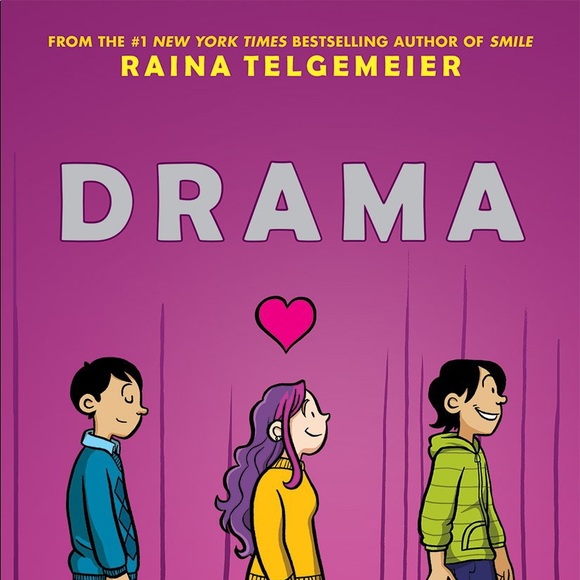
When I started researching various banned books, I laughed out loud when I saw Drama so high on my list, and then I almost cried. This was one of my favorite books in my younger years, by far my favorite graphic novel. I first read this in late elementary school, maybe 4th grade. My mom and I were and still are frequent visitors of the South Milwaukee Public Library, and it was almost always on display there.
Drama takes place at Eucalyptus Middle School, where Callie Marin attends, following the story as she navigates through seventh grade and works on designing the set of the production Moon over Mississippi. Callie deals with your average middle school drama, cycling between a few crushes and friendships. Overall, it’s a coming of age story about inclusion and platonic relationships.
Early in the story, Callie meets and befriends a set of twins, Justin and Jesse. While they are both talented actors and singers, Justin likes to shine on stage while Jesse prefers to be out of the spotlight. This reflects a lot in their personalities, and eventually in the ways they come out of the closet. Justin is openly gay, and his coming out is much more casual. In reference to a boy Callie has a crush on, he says, “I’ve known Greg since second grade. He’s always been thickheaded, even if he is cute.” Callie is a bit surprised and flustered, and when she questions his sexuality, he responds with, “Gay? You can say it! I don’t mind.” They embrace on the next page as Callie warmly tells him, “Your secret’s safe with me.”
This heartwarming scene between Callie and Justin normalizes the idea of coming out during your adolescence and shows that being gay is just a small part of Justin, which Callie is completely accepting of. These days, coming out before high school is much more common than you think. According to the Pew Research Center, 24% of gay men and lesbians under age 30 say they first told a friend or family member that they were gay or lesbian before the age of 15. Being a part of the LGBTQ community is far more normalized now than in previous years, and Callie’s instant acceptance of Justin makes her a great role model for kids reading this book.
Another striking part of this novel is its diverse cast of characters. Not only is there lots of diversity as far as sexualties, but there’s many people of color featured as well. This is especially powerful considering this story is told through art, as there are different skin colors and body sizes on every page. Callie Marin is a white, cisgender, heterosexual girl, but still an amazing ally and advocate through the book.
I’m no stranger to people from different ethnicities and economic backgrounds. South Milwaukee High School has a minority enrollment rate of 41%, and 51% of students are economically disadvantaged as of 2023, according to state data. Still, I often forget that my reality isn’t the case for many students around the country. In 2022, a U.S. Government and Accountability Office Report found that over 30% of students, around 18.5 million students, attended schools where 75% or more of students were the same race or ethnicity. The milestone Brown v. The Board of Education came 70 years ago, yet we’re still feeling the effects of segregated schools. Telgemeier’s novel combats this, as her diverse set of characters prove to students that school is for anyone, no matter your skin color.
The end of the novel reveals that Jesse is also gay, which shocks Callie, as she thought he had been interested in her. Jesse overcomes his stage fright by stepping in for the female lead in the production, sharing a chaste kiss with the male lead, West, effectively saving the whole production. This is a huge moment for Jesse, and it leads him to eventually coming out and developing what might be a relationship with West.
Jesse’s stagefright being compared to his fear of coming out is so captivating. Jesse’s entire development shows the difference between him and Justin. They’re both gay, they just adjust to it differently. This fear of coming out is far too real for many adolescents nowadays. You can’t control who you love, so just imagine how terrifying it is to wonder if you’ll be judged for it. Justin and Jesse posed as my first real exposure to queer characters in the media. I didn’t realize the impact of that until over three years later, when I came out as bisexual. Funnily enough, I was in seventh grade as well, just like Callie. Also, please note that if Jesse and West’s kiss had been between a young girl and boy, no one would have minded.
The final and most prevalent theme in this novel is that of finding a home in theater, specifically stage crew. As someone who’s done stage crew for years, we quite literally slink around the shadows in all black, not getting much acknowledgement. If you can see us doing our jobs, then we’ve done them wrong. Telgemeier outright features the tech crew of Moon over Mississippi, and it makes my theatrical heart so happy!
Theater as a whole is so important to many young people, and that cannot be overstated. I’m currently involved in my school’s production of Chicago, where I’m playing Mama Morton, and rehearsals are seriously the best part of my day. When you’re on that stage you can just tell how much everyone loves the art form. Telgemeier, who grew up in theater, choir, and stage crew, perfectly portrays how impactful youth theater can be.
The diverse cast and themes of friendship in Drama make for a quick but very sweet read. The LGBTQ characters featured are incredibly realistic and amazing role models. People who have attempted to ban this book are grasping at straws, obviously trying to silence LGBTQ voices by claiming that a harmless novel is too mature. Book bannings at a whole have never been to protect our younger generation. They are intended to harm and silence minoritized communities, and we should stop pretending like there is any other goal in mind.
Telgemeier herself doesn’t understand why her book is being banned. In response to being on the ALA’s list of most challenged books for so many years in a row, she wrote, “I had a lot of people asking if I wanted to make a statement, but the statement is the book. My viewpoint is it’s better to live in a world where we love and accept each other than one where we don’t.”



 South Milwaukee Blog