Category Archives: Viewpoints

Regional Issues Require Regional Solutions

Tonight, the South Milwaukee Common Council will hear a presentation from Milwaukee County on its Future State Project —a comprehensive review of how the County delivers services, funds priorities, and plans for long-term stability.

For South Milwaukee residents, this isn’t abstract policy. It’s about the buses we rely on, the parks our families use, and whether the County’s financial structure actually works for communities like ours.


This Matters Here at Home

Sitting on the edge of Milwaukee County, South Milwaukee is close enough to feel regional pressures, but far enough to sometimes feel overlooked. Many of our residents commute to jobs across the county. Families use county parks, the lakefront, trails, and the zoo. We pay county taxes. And when County finances struggle, we feel it.

The Future State Project asks a fundamental question: Is the current structure of County government built to serve today’s needs—or yesterday’s?

Two proposals in particular deserve attention from South Milwaukee residents: a Regional Transit Authority and a dedicated Parks & Zoo District.


Regional Transit

If you live here, you know transportation is regional.

Workers commute north to Bay View, downtown Milwaukee, and beyond. Others travel west to industrial parks and suburban job centers. Students, seniors, and residents without reliable cars depend on transit connections that are often infrequent or indirect.

Milwaukee County Transit System (MCTS) has faced years of financial strain. Funding instability has meant service reductions, longer wait times, and higher fares. When routes are cut or frequencies reduced, South Milwaukee residents feel it—especially those working second or third shifts.

Regional Transit Authority (RTA), currently prohibited under state law, would create a coordinated, stable funding structure across southeastern Wisconsin. The Milwaukee–Waukesha–West Allis metropolitan area (approx. 1.57 million residents) is widely considered one of the largest U.S. metropolitan areas without a comprehensive Regional Transit Authority. Instead of piecing together transit funding year-to-year, a regional model could:

  • Improve connections between South Milwaukee and major job centers
  • Increase service reliability and frequency
  • Strengthen eligibility for federal and state transportation dollars
  • Support long-term planning instead of crisis management
  • Build upon regional commuter rail options

Transit is economic infrastructure. When people can reliably get to work, employers can reliably hire. That benefits South Milwaukee businesses and families alike.


Parks & the Zoo

South Milwaukee residents treasure green space—from our own Grant Park and lakefront access to county-wide destinations.

Milwaukee County Parks and the Milwaukee County Zoo are not luxuries. They are public health infrastructure. They provide gathering spaces, environmental stewardship, recreation, and education.

But for years, these systems have been underfunded. Deferred maintenance has grown. Facilities age. Trails and roads crumble. Staffing levels remain stretched. Because parks funding comes from the County’s general budget, they compete annually with other essential services.

Parks & Zoo District would establish a dedicated funding source with its own levy, allowing:

  • Stable operating funds
  • Faster repairs to aging infrastructure
  • Bonding authority to tackle long-standing maintenance backlogs
  • Reduced pressure on the County’s general fund

For South Milwaukee families who use county parks, pools, trails, and the zoo, this would mean better-maintained spaces and more predictable long-term stewardship.


County Stability Affects South Milwaukee

Milwaukee County’s structural budget challenges don’t stay confined to downtown. When the County struggles, municipalities like South Milwaukee feel ripple effects—whether through service changes, shared costs, or reduced investment.

The Future State Project is about long-term sustainability. It is about building structures that support:

  • Financial stability
  • Equity across communities
  • Reliable services residents depend on

Tonight’s presentation is an opportunity for South Milwaukee elected officials to ask thoughtful questions:

  • How will these proposals impact our taxpayers?
  • How will they improve service reliability?
  • What safeguards ensure accountability and transparency?
  • How can South Milwaukee help shape regional solutions rather than react to them?

South Milwaukee is part of Milwaukee County’s future. Decisions made at the County level affect how we move, where we gather, and how we invest in shared assets.

The Future State Project is not the final word—it is intended to be the beginning of a broader public discussion. As draft recommendations move forward, community feedback will shape what ultimately reaches the County Board.

If we care about mobility, parks, fiscal responsibility, and regional cooperation, this is the moment to engage.

Regional problems require regional solutions—and South Milwaukee deserves a seat at that table.
1 Comment

Filed under City Council, Community, Milwaukee County, Strong Towns South Milwaukee, Viewpoints

What Proposed Changes for Bay View’s Kinnickinnic Ave. Can Teach Us About Building Stronger Streets

The newly released plans for Kinnickinnic Avenue in Bay View aren’t just a redesign. They’re a statement about what kind of places we want to build here in Milwaukee County.

At the center of the conversation is a familiar tension: is traffic calming anti-driver?

No. It’s simply pro-place.

When we design streets at a human scale, we don’t eliminate driving. We just appropriately balance it with the needs of everyone else who uses the corridor: kids walking to school, seniors crossing for groceries, families biking to the park, customers stopping at small businesses. Streets are public spaces first, transportation corridors second.

Here’s what that shift looks like and why it matters.

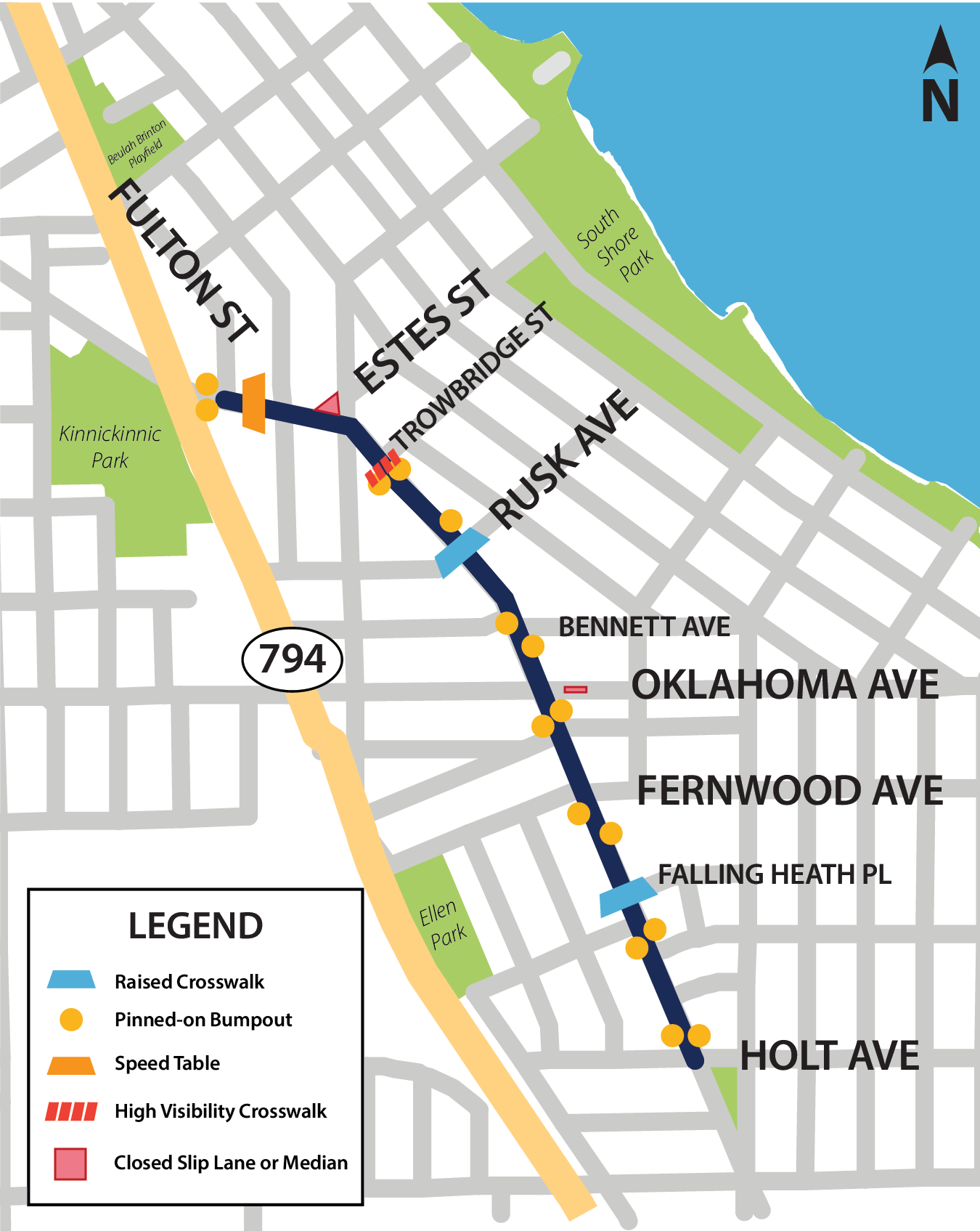
schematic of KK Ave. preliminary Jan 2026 design

Human-Scaled Benefits

A human-scaled street feels intuitive. It communicates, through design, that this is a place where people belong. When lanes are narrower, crossings are shorter, and speeds are moderated, something subtle happens: drivers pay more attention. Pedestrians feel seen. Businesses feel more accessible.

Instead of a corridor that people rush through a place, you get a street people spend time (and money) on.

That matters because comfort determines behavior. If crossing the street feels risky, fewer people will walk. If biking feels stressful, fewer families ride. If a parent doesn’t trust the intersection near a school, they drive instead—adding more congestion to the very street we’re trying to “speed up.”

Human-scaled design reduces that friction.


Economic Benefits

Commercial streets are economic engines. But high speeds and highway-style geometry undermine their productivity.

When vehicles move fast, drivers are less likely to notice storefronts, less likely to stop spontaneously, and more likely to treat the corridor as a pass-through route. Slower, steadier traffic increases visibility and access. It also reduces crash severity, which protects property, and reduces long-term public costs.

Small businesses thrive in environments where:

  • People feel safe walking between shops.
  • Parking maneuvers aren’t stressful.
  • Outdoor seating doesn’t feel exposed to speeding traffic.
  • Families linger instead of hurry.

Across the country, communities that retrofit overly wide corridors into people-centered streets see increases in foot traffic and commercial vitality. It’s about designing for productive land use.


School Zone Safety

Traffic calming becomes especially important near schools. Schools like Bay View’s Fernwood Elementary and Trowbridge School of Great Lake Studies which fall along KK Ave.

Children judge speed and distance differently than adults. They’re smaller, less visible over parked cars, and more likely to act unpredictably. A street that feels “fine” to a confident adult can feel overwhelming and dangerous to a child.

When we redesign streets near schools with raised crossings, tighter corners, and clearer pedestrian space, we send a message: this is a place where kids come first.

Safer school zones don’t just reduce crashes. They:

  • Encourage active transportation—walking and biking.
  • Reduce chaotic drop-off traffic.
  • Build independence for young people.
  • Lower stress for parents.

A community that protects its youngest residents builds trust. This is a lesson we should internalize here in South Milwaukee.


How These Specific Interventions Work

The tools proposed for Kinnickinnic Avenue are proven, practical, and increasingly common. They’re backed by science and best practices. Here’s what each one does:

Raised Crosswalks

A raised crosswalk elevates the crossing to sidewalk level. Drivers must slow as they approach, because the roadway physically rises.

Why they work:

  • Forces lower vehicle speeds at conflict points.
  • Improves pedestrian visibility.
  • Signals clearly that people crossing have priority; ensuring compliance with yielding laws.
  • Enhances accessibility for people using mobility devices by creating a flush crossing surface.

Bumpouts (Curb Extensions)

Bumpouts extend the sidewalk into the parking lane at intersections or mid-block crossings. Shorter crossings mean less time exposed in the street; especially important for seniors and children.

Why they work:

  • Shorten pedestrian crossing distance.
  • Improve sightlines between drivers and pedestrians.
  • Prevent dangerous parking too close to intersections.
  • Calm turning speeds by tightening corner radii.

Speed Tables

Speed tables are long, gently sloped raised sections of roadway. They are flatter and broader than traditional speed humps.

Why they work:

  • Reduce mid-block speeding.
  • Maintain smoother ride quality than abrupt humps.
  • Encourage consistent, steady speeds rather than fast acceleration between signals.
  • Improve comfort for buses and emergency vehicles compared to sharper devices.

High-Visibility Crosswalks

These use bold striping patterns instead of thin parallel lines. Visibility affects driver behavior. Clear markings reduce ambiguity.

Why they work:

  • Increase recognition at greater distances.
  • Improve nighttime and wet-weather visibility.
  • Reinforce pedestrian priority at intersections.

Closing Slip Lanes

Slip lanes allow right-turning drivers to bypass intersections without fully stopping. Closing them reclaims space for pedestrians and simplifies intersections.

Why it works:

  • Eliminates high-speed turning conflicts.
  • Reduces pedestrian exposure to multiple crossing points.
  • Makes intersections easier to navigate for everyone.
  • Reclaims space for public use, landscaping, or bike infrastructure.

Lessons to Learn

  1. Design communicates values. If a street feels like a highway, people will drive it like one.
  2. Speed is the key variable. Lower speeds dramatically reduce crash severity.
  3. Safety and prosperity are linked. Productive corridors depend on comfort and access.
  4. Small changes compound. Together traffic calming interventions reshape driver behavior.

The conversation around Kinnickinnic Avenue isn’t just about Bay View. It’s about what kind of streets we want throughout Milwaukee County, including our South Milwaukee home.

We can build corridors that move cars quickly. Or we can build places where people want to be.

The strongest towns choose the latter and design accordingly.

Leave a comment

Filed under South Milwaukee, Strong Towns South Milwaukee, Viewpoints

Civic Pride Doesn’t Have to be Serious (or Divisive)

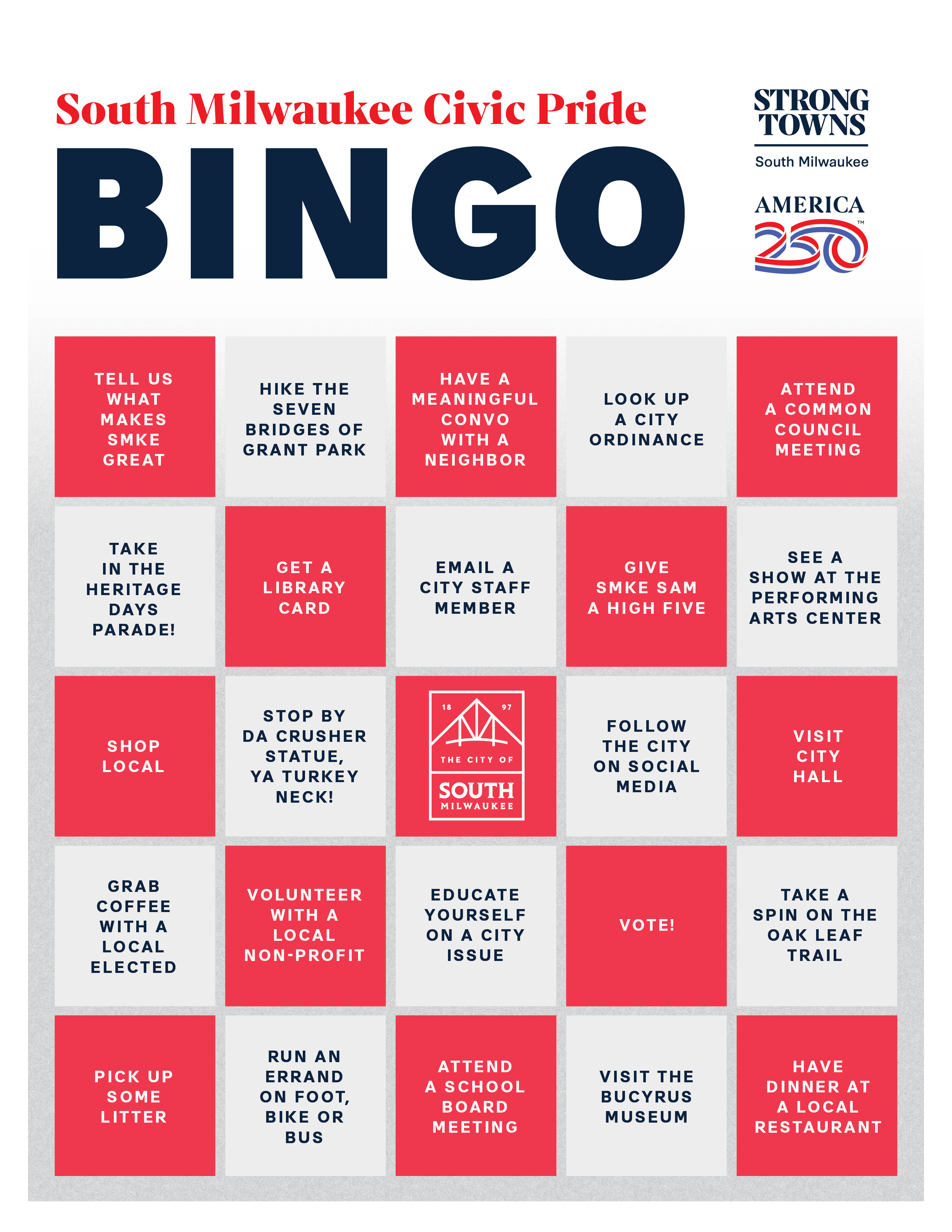
Just for fun, I tried to turn civic pride into a game. 😄

As a committed and concerned community member (…and Strong Towns South Milwaukee member), I spend an inordinate amount of time reading, researching and talking about (sometimes) contentious municipal topics—things like infrastructure, budgets, zoning changes, school board proposals, our library, and long-term comprehensive planning. All incredibly important stuff! But sometimes civic life can start to feel… heavy. 

I wanted to remind myself—and our neighbors—that loving this city can be simple, joyful, and even a little silly.

Introducing South Milwaukee Civic Pride Bingo—because civic pride doesn’t have to be serious to be meaningful. No prizes, no pressure, just a fun excuse to explore the city, support local, and appreciate the everyday stuff that makes South Milwaukee feel like home.

A bingo game card

Meetings, debates, campaigns, referendums, arguments on social media, “us vs. them” conversations about politics and priorities. It’s easy for people to feel burned out, disconnected, or like civic engagement is only for policy wonks and activists.

Civic pride doesn’t always have to look like a town hall meeting or a heated comment thread. Sometimes it looks like grabbing a massive cookie from Bakehouse 23, finding a segment of Oak Leaf Trail you never knew existed, attending a community event with friends, or stopping to admire a mural downtown you’ve driven (or biked…) past a hundred times. Those everyday experiences are civic life, too.

I know so many of us really, really love this place. Like, bigger love than South Milwaukee Sam love.

We love South Milwaukee not because it’s perfect, but because it’s ours. Because of the people who show up, the institutions that quietly hold things together, and the small moments that make it feel like home.

That’s the spirit behind Civic Pride Bingo. It’s not about being right, or winning arguments, or proving how engaged you are. It’s about reconnecting with the places and people that make up our shared community, in a way that feels accessible and fun instead of intimidating or divisive.

As we head toward America 250 this July, I hope we’ll have many national conversations about what it means to be part of a country, a democracy, a civic culture. But I think the best place to start is local. Civic pride isn’t built in faraway places—it’s built on our sidewalks, in our library, in our parks, on our beaches,, in our small businesses, and in the conversations we have with our neighbors.

My hope is simple: that this little Bingo game sparks a little more curiosity, a little more joy, and a little more love for South Milwaukee. Because strong towns aren’t just built with plans and policies—they’re built with people who care. And caring, it turns out, doesn’t have to be so serious all the time.

Leave a comment

Filed under South Milwaukee, Strong Towns South Milwaukee, Viewpoints

Real change is coming to 12th Ave. & Milwaukee Ave.

On Tuesday night, the city’s Public Works & Public Property Committee approved six-month, interim safety improvements at one of South Milwaukee’s most challenging intersections—12th Ave and Milwaukee Ave.

The approved changes include removing the first on-street parking space closest to the intersection to improve sightlines, adding a high-visibility stop sign on the northwest corner, and potentially upgrading the stop sign on the southeast corner.

The city engineer designed the plan to expand the vision triangles to Manual on Uniform Traffic Control Devices (MUTCD) standards, exceeding what current South Milwaukee code requires. Both the Police Chief and officers shared that, based on experience, high traffic volumes and poor visibility are major contributors to collisions here.

We’re encouraged to see the city take practical, low-cost action instead of waiting years for a full reconstruction or a $20,000 traffic study. This is exactly the kind of “try something, measure it, improve it” approach we support.

So what does success look like for this intervention?

So far, the conversation has focused almost entirely on drivers. From a Strong Towns perspective, success should also be measured by how this intersection works for everyone.

That means looking for fewer crashes and near-misses, lower vehicle speeds approaching the intersection, and better visibility for all users. It also means more comfortable crossing for pedestrians, greater predictability for people biking, and, just as importantly, fewer residents saying that “this intersection feels bad.”

In other words, not just does traffic move — but does this place feel safer to be in?

We applaud the city for taking this first step. Now let’s use this pilot to collect data, listen to residents, and keep moving toward a safer South Milwaukee.

Leave a comment

Filed under Strong Towns South Milwaukee

Shelby’s Banned Book Reviews: “Drama”

I am proud to offer this space to my daughter, Shelby, who will be writing series of book reviews of banned books. Get in some good trouble, kid!

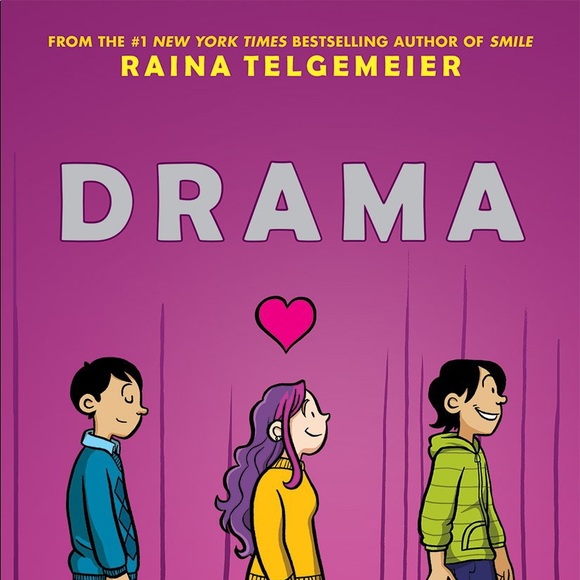
From the time it was published in 2012, the graphic novel Drama by Raina Telgemeier underwent heavy criticism. It was #2 on the American Library Association’s most challenged books in 2016, only falling to #3 in 2017. It was also challenged in 2014 for being “sexually explicit.” Its inclusion of LGBTQ characters was labeled as being “confusing” and against “family values.” Despite all of this controversy, Drama was a widely celebrated novel. Some of the book’s achievements include winning the Stonewall Book Award in Children’s and Young Adult Literature in 2013, receiving a nomination for a Harvey Award, and being listed as a Best Book of 2012 by Publishers Weekly, The Washington Post, and School Library Journal.

When I started researching various banned books, I laughed out loud when I saw Drama so high on my list, and then I almost cried. This was one of my favorite books in my younger years, by far my favorite graphic novel. I first read this in late elementary school, maybe 4th grade. My mom and I were and still are frequent visitors of the South Milwaukee Public Library, and it was almost always on display there. 

Drama takes place at Eucalyptus Middle School, where Callie Marin attends, following the story as she navigates through seventh grade and works on designing the set of the production Moon over Mississippi. Callie deals with your average middle school drama, cycling between a few crushes and friendships. Overall, it’s a coming of age story about inclusion and platonic relationships.

Early in the story, Callie meets and befriends a set of twins, Justin and Jesse. While they are both talented actors and singers, Justin likes to shine on stage while Jesse prefers to be out of the spotlight. This reflects a lot in their personalities, and eventually in the ways they come out of the closet. Justin is openly gay, and his coming out is much more casual. In reference to a boy Callie has a crush on, he says, “I’ve known Greg since second grade. He’s always been thickheaded, even if he is cute.” Callie is a bit surprised and flustered, and when she questions his sexuality, he responds with, “Gay? You can say it! I don’t mind.” They embrace on the next page as Callie warmly tells him, “Your secret’s safe with me.”

This heartwarming scene between Callie and Justin normalizes the idea of coming out during your adolescence and shows that being gay is just a small part of Justin, which Callie is completely accepting of. These days, coming out before high school is much more common than you think. According to the Pew Research Center, 24% of gay men and lesbians under age 30 say they first told a friend or family member that they were gay or lesbian before the age of 15. Being a part of the LGBTQ community is far more normalized now than in previous years, and Callie’s instant acceptance of Justin makes her a great role model for kids reading this book. 

Another striking part of this novel is its diverse cast of characters. Not only is there lots of diversity as far as sexualties, but there’s many people of color featured as well. This is especially powerful considering this story is told through art, as there are different skin colors and body sizes on every page. Callie Marin is a white, cisgender, heterosexual girl, but still an amazing ally and advocate through the book. 

I’m no stranger to people from different ethnicities and economic backgrounds. South Milwaukee High School has a minority enrollment rate of 41%, and 51% of students are economically disadvantaged as of 2023, according to state data. Still, I often forget that my reality isn’t the case for many students around the country. In 2022, a U.S. Government and Accountability Office Report found that over 30% of students, around 18.5 million students, attended schools where 75% or more of students were the same race or ethnicity. The milestone Brown v. The Board of Education came 70 years ago, yet we’re still feeling the effects of segregated schools. Telgemeier’s novel combats this, as her diverse set of characters prove to students that school is for anyone, no matter your skin color. 

The end of the novel reveals that Jesse is also gay, which shocks Callie, as she thought he had been interested in her. Jesse overcomes his stage fright by stepping in for the female lead in the production, sharing a chaste kiss with the male lead, West, effectively saving the whole production. This is a huge moment for Jesse, and it leads him to eventually coming out and developing what might be a relationship with West. 

Jesse’s stagefright being compared to his fear of coming out is so captivating. Jesse’s entire development shows the difference between him and Justin. They’re both gay, they just adjust to it differently. This fear of coming out is far too real for many adolescents nowadays. You can’t control who you love, so just imagine how terrifying it is to wonder if you’ll be judged for it. Justin and Jesse posed as my first real exposure to queer characters in the media. I didn’t realize the impact of that until over three years later, when I came out as bisexual. Funnily enough, I was in seventh grade as well, just like Callie. Also, please note that if Jesse and West’s kiss had been between a young girl and boy, no one would have minded.

The final and most prevalent theme in this novel is that of finding a home in theater, specifically stage crew. As someone who’s done stage crew for years, we quite literally slink around the shadows in all black, not getting much acknowledgement. If you can see us doing our jobs, then we’ve done them wrong. Telgemeier outright features the tech crew of Moon over Mississippi, and it makes my theatrical heart so happy! 

Theater as a whole is so important to many young people, and that cannot be overstated. I’m currently involved in my school’s production of Chicago, where I’m playing Mama Morton, and rehearsals are seriously the best part of my day. When you’re on that stage you can just tell how much everyone loves the art form. Telgemeier, who grew up in theater, choir, and stage crew, perfectly portrays how impactful youth theater can be.

The diverse cast and themes of friendship in Drama make for a quick but very sweet read. The LGBTQ characters featured are incredibly realistic and amazing role models. People who have attempted to ban this book are grasping at straws, obviously trying to silence LGBTQ voices by claiming that a harmless novel is too mature. Book bannings at a whole have never been to protect our younger generation. They are intended to harm and silence minoritized communities, and we should stop pretending like there is any other goal in mind. 

Telgemeier herself doesn’t understand why her book is being banned. In response to being on the ALA’s list of most challenged books for so many years in a row, she wrote, “I had a lot of people asking if I wanted to make a statement, but the statement is the book. My viewpoint is it’s better to live in a world where we love and accept each other than one where we don’t.” 

Leave a comment

Filed under Shelby's Banned Books, South Milwaukee, Viewpoints

Shelby’s Banned Book Reviews: “Looking for Alaska”

I am proud to offer this space to my daughter, Shelby, who will be writing series of book reviews of banned books. Get in some good trouble, kid!

John Green’s first novel Looking for Alaska appeared on the American Library Association’s list of the top 10 most challenged books in 2012, 2013, 2015, and 2016, as it was claimed to be sexually explicit. In 2022 alone, this novel was challenged 50 times. This book is often labeled “poronography” by those who wish to ban it, much to the dismay of Green. 

Looking for Alaska follows protagonist Miles “Pudge” Halter, who transfers to a boarding school in Culver Creek in search of his own “Great Perhaps.” At school, Pudge becomes close with his roommate Chip Martin, nicknamed the Colonel, and they form their own type of breakfast club with the only Japanese student, Takumi, Romanian immigrant Lara, and the unpredictable Alaska Young. Throughout the book, Pudge and Alaska explore what it means to escape the labyrinth of life, discovering themes of grief, economic class division, adolescent drinking, and friendship. 

The Colonel acts as the ringleader of their group, planning strategies for all of their pranks. The interesting aspects of his character are shown through his poor background but undying loyalty to his beloved mother. When asked about the best day of his life, Colonel looks towards the future instead, describing his perfect day as the day when he buys his mother a new house so she can move out of their trailer, finally finding a way to thank her for all she’s done for him. When Alaska’s unexpected death comes later in the novel, Colonel despises any students who he believes don’t have the right to grieve because they didn’t know Alaska well enough. He’s the main one who tries to find an explanation for her death, and he heavily resists the idea of her committing suicide when it first comes up.

With economic divides at all time highs in our country, the class divide at Culver Creek feels awfully real, as the richer students obviously have a lot more pull than the poor ones. As a student in an impoverished district, this poor background is a reality for many of my peers. There’s a belief from upper class people that being poor is horrendously sad and debilitating, but Colonel is the perfect example of making the best out of your situation. Throughout the book, Colonel proves that your background does not have to define you, which is a thoughtful sentiment that still holds true today, two decades after the book is set.

This book has been most often challenged for its “pornography,” though, as someone who just finished the book, its intimate scenes are anything but. There’s only one real sex scene in the novel, and it’s described by John Green as “awkward, unfun, disastrous, and wholly unerotic.” This is followed directly by a scene with no physical intimacy but more raw emotion than we’ve seen so far. Green uses this contrast to actually advise against teenage physical intimacy, as it ends up feeling rather emotionless. He instead points out that you can have lovely tender moments without skin on skin contact. 

According to the CDC, over half of U.S. teens have had sexual intercourse by age 18 in the year 2017. Underage sex is something that has always existed, and the numbers are only rising. One of the downfalls to our increasingly digital world is the fact that access to pornography is at the fingerprints of young adults. Instead of shaming and degrading the idea of underage sex, we should focus more on increased access to inclusive sex education. It’s proven that comprehensive sex education programs actually reduce the rates of sexual activity as a whole. In Looking for Alaska, Green uses non arousing almost medical terminology in any intimate scenes, treating these parts of the novel as a form of sex ed. Green, along with many other YA authors, argues that books that include teen romance and intimacy should not be labeled as pornography.

When Alaska decides to drive drunk and ultimately dies because of it, it’s arguably the most impactful moment of the book. After the accident, Pudge grapples with the fact that he might’ve enabled this by letting Alaska get behind the wheel, feeling a tremendous amount of guilt in the midst of his grieving process. Colonel and Takumi blame themselves as well. It’s pointed out later that this accident may have instead been suicide, but it’s eventually left up to the reader to decide.

This is the part of the book that struck me the most, as I noticed the warning signs written in the pages but I couldn’t do anything about it. That feeling of complete helplessness is probably similar to how Pudge and the others felt when they received the news of Alaska’s tragic death. As stated by the Childhood Hospital of Philadelphia, 19% of alcohol-impaired drivers involved in fatal car crashes were between 15 and 20 years old in the year 2022. Driving under the influence of alcohol or maurijana isn’t nearly as rare as it should be for teens. 

There’s a thought that things like that don’t happen in South Milwaukee, but I can strongly say that I know of far too many cases of underage driving under the influence in the past year alone. I’ve even had to deal with some of these issues firsthand.  After reading this, I’m even more inclined to raise my voice when one of my peers may want to drive under the influence. What happened to Alaska is the worst case scenario, but it’s a scenario that happens all too often. Whether Alaska really was too drunk to notice her mistake or she drove into the cop cruiser on purpose, she likely wouldn’t have done the same thing sober. Censoring this cautionary tale of drinking and driving is a disservice to anyone my age, as fatalities are far more common if we aren’t educated on the dangers of driving under the influence. 

This novel is also one that heavily questions the idea of religion and the afterlife. It’s a book that criticizes Buddishm, Christianity, and atheism alike, not picking a side but instead stating that all can be true. Just before Alaska’s death, Pudge explores the idea of the afterlife for himself. “People, I thought, wanted security. They couldn’t bear the idea of death being a big black nothing, couldn’t bear the thought of their loved ones not existing, and couldn’t even imagine themselves not existing. I finally decided that people believed in an afterlife because they couldn’t bear not to.” I understand why Christian Conservatives choose to challenge this book in particular, since it happens to criticize the very religion they follow.

As Alaska Young grapples with her obvious mental illness and childhood trauma, she asks a question that I feel the need to ask my friends on occasion: “Don’t you know who you love, Pudge? You love the girl who makes you laugh and shows you porn and drinks wine with you. You don’t love the crazy, sullen bitch.” I think it’s unfortunate how true this is for myself and so many others. I often wonder if people would love me the same if I was always in the midst of an anxious episode, if I wasn’t kind and upbeat all the time. 

Before this, she shows a strong aversion to wanting to go home for the holidays. “I’m scared of ghosts, Pudge. And home is full of them.” Alaska’s fear of going home is due to her trauma around her mother dying in front of her and her father blaming her for it. This self hatred is an eventual cause for her death, whether it was suicide or accidental. When Alaska is asked about her favorite day ever, she recalls the day before her mothers death, when they went to the zoo together. Alaska’s trauma and mental illness is what makes her so relatable to readers.

Most YA books published around 2005 were sci-fi and fantasy, with unrelatable characters, which is what makes Looking for Alaska all the more powerful. John Green weaves his story with complex friendships, class division, teen intimacy, and driving under the influence all in one. When describing why he wrote the book, Green says, “I wanted to write about sexuality and substance abuse because it felt true to the characters. When you’re a teenager, you’re doing all kinds of important things for the first time, and in writing Alaska I wanted to deromanticize some of those firsts.” 

Green’s debut novel is a powerful tale that shows a group of teenagers constantly seeking what makes them feel alive, giving up their safety in order to do so. I believe that Pudge’s final essay sums this up perfectly. “Those awful things are survivable, because we are as indestructible as we believe ourselves to be. When adults say, “Teenagers think they are invincible” with that sly, stupid smile on their faces, they don’t know how right they are. We need never be hopeless, because we can never be irreparably broken. We think that we are invincible because we are. We cannot be born, and we cannot die. Like all energy, we can only change shapes and sizes and manifestations. They forget that when they get old. They get scared of losing and failing. But that part of us greater than the sum of our parts cannot begin and cannot end, and so it cannot fail.”

2 Comments

Filed under Shelby's Banned Books, South Milwaukee, Viewpoints

Shock, Awe, and Fear

This weekend, it was about instigating a trade war … and handing over payment systems, our personal data, and the power to reshape our goverment to the world’s richest man. It was about dismantling an agency in USAID that exists to help those most in need across the globe.

Today it’s about plans to eliminate the Department of Education.

Before that, in just the first two weeks of the Trump presidency, it was the pardoning hundreds of people convicted of beating cops … unilaterally freezing federal funding and foreign aid … ordering the end to birthright citizenship … the start of mass deportation raids, with little regard to sweeping up non-criminals … rolling back LGBTQ protections … threatening to withhold funding from local schools if teaching doesn’t align with conservative principles … removing security protection from perceived enemies … encouraging federal workers to quit their jobs en masse, while firing others who he considers a threat … pledging to condition federal disaster aid on political outcomes … blaming DEI and past administrations for the Washington D.C. air disaster. And much more.

This projectile vomiting of executive branch action makes me wistful for the good old days when we just wanted to seize Greenland and take back the Panama Canal — maybe by force.

MAGA 2.0 scares the hell out of me, and it should scare you too. But that’s the point, right? A shock and awe strategy like this is meant to cause chaos and stoke fear.

Fear of being deported. Fear of losing your job. Fear of people that don’t look like us. Fear of discrimination, or worse, in diverse communities. Fear of not getting emergency aid when you just lost your home in a wildfire. Fear of higher prices sure to come with tariffs. Fear of not receiving the federal funding you and your agency rely on to educate our kids, slow the spread of disease, feed the hungry, and care for the elderly and veterans. Fear of your personal information being misused by Elon Musk in the name of “government efficiency.” For our allies, fear of us not being there when they need us most.

Fear has defined these first couple weeks of the Trump presidency. And that’s just how he wants it.

Some would call this strategy courageous and bold, an example of “promises made, promises kept” and the result of a mandate handed down in November. “Winning!” they call it.

I call it reckless, irresponsible, and dangerous — a convenient forgetting of the fact that Trump won the popular vote by 1.5%, and more than half of America didn’t even vote for him.

Leadership by threats and intimidation is not leadership at all. It is the opposite.

Good leaders unite, not divide. They inspire, encourage, and compassionately care for others, starting with the most vulnerable. They act strategically. They embrace diverse viewpoints, surrounding themselves not with loyalists but with smart, experienced people willing to challenge preconceived ideas — and then listen to them. They accept accountability, not blame others. They find strength in working together to solve problems, not isolate. They calm fears, not stoke them.

They understand winning is not the “Art of the Deal” or an epiode of the “The Apprentice.” They know winning is not transactional — not a series of disjointed moves and countermoves to satisfy a mandate that never existed. It not a short-term result to score a political talking point, like a 30-day pause in a stupid trade war that we started because we could — long-term implications with our closest allies be damned. It is not isolationism. It is not dismantling the workings of goverment in days without regard for the real damage being inflicted and without a real plan for what’s next.

Which brings me to “what’s next?”

I, like many, have struggled with how to respond to this, which is exactly how President Trump wants it with this “flood the zone” approach to governing.

I turn back to what I wrote after the November election, to my daughter.

First, we accept the results of the election.

Start there – at a place too many never got to the last time we did this. Donald Trump won. You may not like it, but win or lose, you accept the results. That’s what we do as American citizens. You don’t try to undo the results, lie about them, and stand by while others use violence to invalidate them. 

That’s life lesson #1: Lose the right way.

Check. There was a peaceful transition of power some (since pardoned) tried to prevent 2021.

Then you live your life. You get up, go to school, go to work, go to theater and choir rehearsal. You keep working hard in the classroom. You hang out with your friends and family. You keep volunteering. You keep helping others. You keep being a 16-year-old girl who is so much more than one political outcome. 

Check. The sun continues to rise, and my daughter continues to shine. She’s also 17 now.

You also keep fighting for what you believe in. Work for positive change, resisting the urge to go low. Let others spew hate and divide. You love and unite. 

Stand up for LGBTQ+ rights, a woman’s right to choose, common sense gun control, immigrants, and the countless other issues you are so passionate about. Do your part to lift up the most vulnerable among us. Resist those bent on doing otherwise … while always remembering, despite Tuesday’s results, how you act, what you say and how you say it, matters. I will always believe that. Do good, embrace hope, and get to work. Start with your family, your school, and in your community. Then go bigger.

Check. Shelby continues to be a passionate advocate for what’s right — and is now sharing her perspective on this blog through the “Shelby’s Banned Book Club” series. Part 1 — “The Perks of Being a Wallflower” — ran last week. Part 2 runs later this week.

We can join her in making a difference. I suggest it starts locally. Speak up using whatver platform you have. It doesn’t have to be a website or social media; in fact, I’d suggest it not be on social media these days. A conversation over coffee can help. Contact your elected officials, from your alderman to your president. Attend a government meeting and speak. Vote. Volunteer your time or financially support an organization helping those most impacted by what’s happening in Washington D.C. right now.

Be there for someone who is scared. It’s a start.

12 Comments

Filed under Viewpoints

Introducing Shelby’s Banned Book Reviews: “The Perks of Being a Wallflower”

I am proud to offer this space to my daughter, Shelby, who will be writing series of book reviews of banned books. Get in some good trouble, kid!

According to PEN America, over 10,000 books were banned in public schools during the 2023-2024 school year as compared to the previous year with 3,362. This is not the first time that books have become political. Shakespeare faced censorship from Queen Elizabeth I in the year 1601, and New English Canaan by Thomas Morton was banned in 1637, as it was harshly critical of the puritans genocide of the Indegenous population. Nazi Germany burned over 100 million books across Europe by the end of WWII. 

Nowadays, books are challenged for a plethora of reasons. The most prominent reason for bannings is the inclusion of sexual content or offensive language, but the options are endless. Books with LGBTQ+ content have recently come under scrutiny, as well as books containing violence, abortion, suicide, mental health issues, or religious viewpoints. LGBTQ+ and BIPOC voices are disproportionately targeted with book bannings.

For a country that claims to stand for freedom, censorship is not the answer. The most essential part of humanity is learning from our mistakes in history, and banning books with unique viewpoints completely erases marginalized voices. This severely limits and damages the education of our future generations.

From a young age, my parents taught me that when I see something I don’t like, I should resist. With more and more books being challenged every year, I know that this is something I am ready and willing to fight. Diverse literature is necessary for a thriving young generation and generally educated population. Hearing from different voices in literature is how we come to an understanding of different viewpoints. 

So, with resistance in mind and freedom driving me, I will write reviews on banned books. I will recognize why they’re being challenged, explain how the story is necessary to hear, and analyze complex characters and themes that we can all relate to. Through this series of reviews, I hope we can learn to include rather than exclude. 

As Oscar Wilde wrote in The Picture of Dorian Gray, “The books that the world calls immoral are books that show its own shame.” 


Book Review #1: The Perks of Being a Wallflower

The Perks of Being a Wallflower by Stephen Chbosky was first banned way back in 2003 in Fairfax, Virginia by a group called Parents Against Bad Books in Schools. This was only four years after it was published in 1999. Since then it has been heavily targeted by book banning efforts, mostly due to it’s themes of drugs use, childhood incest, homosexuality, and profanity. From 2002 to 2010 it was banned publicly eleven times, and it’s only gotten more controversial with the passage of time, as it was challenged 68 times in 2023. 

This novel is set in the 1990s, following quiet, awkward, but deeply kind Charlie, a freshman in high school. As Charlie navigates through a complicated year, the reader gets to learn and grow with him as he overcomes his anxiety and PTSD.

The plotline of Charlie’s older sister shows an abusive high school relationship. At the beginning of the book, Charlie’s sister’s boyfriend hits Charlie’s sister in secret, with Charlie being the only person to witness it. Charlie is shocked by his sister’s reaction or lack thereof. He comments on the fact that his sister is a feminist and has a strongly opinionated personality, but when faced with violence from a lover, she freezes and takes it. This also shows a parallel to Charlie’s mother, who is a much more passive type of person. 

Make no mistake, a woman being beaten by her boyfriend is not just a product of this time in history, as domestic abuse is still a very prevalent issue today. According to the Children’s Hospital of Philadelphia, 1 in 3 teens in the US are victims of teen dating violence, whether that be physical, sexual, verbal, or emotional abuse. This portrayal is undeniably raw, as Charlie’s sister still wants to stay with her boyfriend even after he’d hit her, showing a cycle of abuse. 

As Charlie becomes close with Patrick, it’s safe to assume that Patrick and Brad’s queer relationship serves as a large point of controversy in this novel, though it really should be anything but. I’m a huge advocate for queer representation in all types of media, but the representation doesn’t really mean anything unless it feels truly real. I can see myself in parts of Patrick and Brad’s relationship. I deeply understand the fear of coming out, but the sense of community that being queer brings to you. 

Later in the story, Brad falls victim to peer pressure, child abuse, and what I like to call Closet Case Syndrome. His father accidentally walks in on Patrick and Brad, and he proceeds to beat Brad unconscious. A few days later, when Patrick attempts to talk to Brad in school, Brad calls him a homophobic slur twice, and a brawl ensues. Charlie luckily comes to the defense of Patrick. I think the most engaging part of Patrick and Brad’s plotline comes just after this, when Brad directly thanks Charlie for jumping to defend Patrick. This shows that Brad still deeply cares for Patrick and knows what he said was wrong.

LGBTQ+ teens are far more likely to experience child abuse from family members and bullying from peers. The stigma around homosexuality is debilitating at times, also leading to a much higher risk for suicide for LGBTQ+ youth. While Patrick and Brad don’t have an entirely healthy relationship, they serve as a harsh reality check for the horrors LGBTQ+ people face. This representation is necessary because of just how realistic it is.

Charlie’s grandfather has a relatively minor role in the book, but he is a very compelling character when you look beneath the surface. I read this book for the first time years ago, and I remember writing his character off as a racist small-minded old white guy, but I’m beginning to see just how complex he really is. Charlie’s grandpa had to work very hard as a teenager, and his endless work eventually paid off as he got to make a better future for his two daughters. One day, when his daughters come home with C’s on their report cards, he beats them as a warning to improve their grades. While this is definitely harsh and unnecessarily violent, it’s also understandable. While Charlie’s grandfather’s childhood cannot be seen as an excuse, it’s a perfect explanation.

People are not just black and white, and Charlie’s grandfather is a direct representation of that. He can be classified as abusive considering he beat his daughters, but in his mind, he was doing it so they would improve their grades and have a better future. Humanity is complex and violent and beautiful, and the first step we can take towards a better future is understanding people who are different from us.

This book is one of my favorites ever because every character just feels so real. Seriously, I know I’m going to go to school tomorrow and see half of these characters in the hallway, dealing with the same struggles. In an interview in 2013, Stephen Chbosky claimed, “For many kids, the book helped end a sense of isolation. It ended the idea that they were all alone in what they were going through, whether they were gay and they thought they were going to be punished for that, or if they were struggling with mental illness or depression and they thought that it never gets better. Charlie’s struggles, and his friends’ struggles, speak directly to those experiences.” 

Banning The Perks of Being a Wallflower silences a million different voices, but more than anything, it erases the sense of hope that this book brings you. Hope for a better future, where you can feel safe to come out, overcome abusive relationships, and give your children a better future. 

At the very end of the book, Charlie reflects on this past year and all that he’s learned, encouraging the readers that our obstacles don’t define us. He states, “I guess we are who we are for a lot of reasons. And maybe we’ll never know most of them. But even if we don’t have the power to choose where we come from, we can still choose where we go from there. We can still do things. And we can try to feel okay about them.” 

Helpful Websites

9 Comments

Filed under Shelby's Banned Books, Viewpoints

The Future of This Blog

I launched this website 15 years ago with a vision to engage the South Milwaukee community on local news and information they couldn’t get anywhere else, packaged in the way I package it.

1.8 milllion views, 600,000 visitors, and more than 4,000 posts later, I’ve been thinking a lot about what’s next for this platform, especially at this point in my life and at this point in history.

My conclusion: It’s time for a new approach. Now, more than ever.

What won’t change: A focus on local news and information. I will still do my best to keep South Milwaukeeans informed on key issues, from city and schools news to election coverage to items on local sports, business and people. For example, look for updates on the Mill Pond Dam this week, and local candidate profiles in February. I will also still seek to provide the most comprehensive list of local events in the city, as I have done since I relaunched the blog in 2023.

At the same time, I have shit to say and the platform to say it. So I will use it.

Especially now, at a time in our history when our president chooses to spend his first week back in office grabbing power for the executive branch, attacking his perceived enemies, settling old scores, targeting our most vulnerable, rewarding his loyalists, and further dividing our country … from pardoning cop beaters to unilaterally pausing federal grant funding (for a day) to threatening to make federal disaster aid conditional on political aims to choosing to blame DEI and the past administration for the Washington D.C. helicopter-plane crash 12 hours after it happened.

It’s shock and awe, and it’s shameful. And I can’t stay silent on it.

You can expect more opinion on these pages as we go forward, as I share viewpoints on world, national, state, county and local issues I find important — both my own words and others, including my daughter. “Shelby’s Banned Book Reviews” debuts this week.

Heck, I may even throw in a few hot Brewers takes.

You will be able to access this content under Viewpoints in the menu bar.

Almost 1,000 people subscribe to this blog, and if you don’t like this approach, or if you’re not comfortable reading views that might challenge your own, please unsubscribe. No hard feelings. If you’re OK with it, please keep reading and tell others to subscribe.

Thanks for joining me on this journey. Here’s to another 15 years.

11 Comments

Filed under Viewpoints