Category Archives: Strong Towns South Milwaukee

Perspectives and information from a group of citizens who advocate for South Milwaukee to be safe, livable, financially strong, resilient, inclusive, and inviting.

What Proposed Changes for Bay View’s Kinnickinnic Ave. Can Teach Us About Building Stronger Streets

The newly released plans for Kinnickinnic Avenue in Bay View aren’t just a redesign. They’re a statement about what kind of places we want to build here in Milwaukee County.

At the center of the conversation is a familiar tension: is traffic calming anti-driver?

No. It’s simply pro-place.

When we design streets at a human scale, we don’t eliminate driving. We just appropriately balance it with the needs of everyone else who uses the corridor: kids walking to school, seniors crossing for groceries, families biking to the park, customers stopping at small businesses. Streets are public spaces first, transportation corridors second.

Here’s what that shift looks like and why it matters.

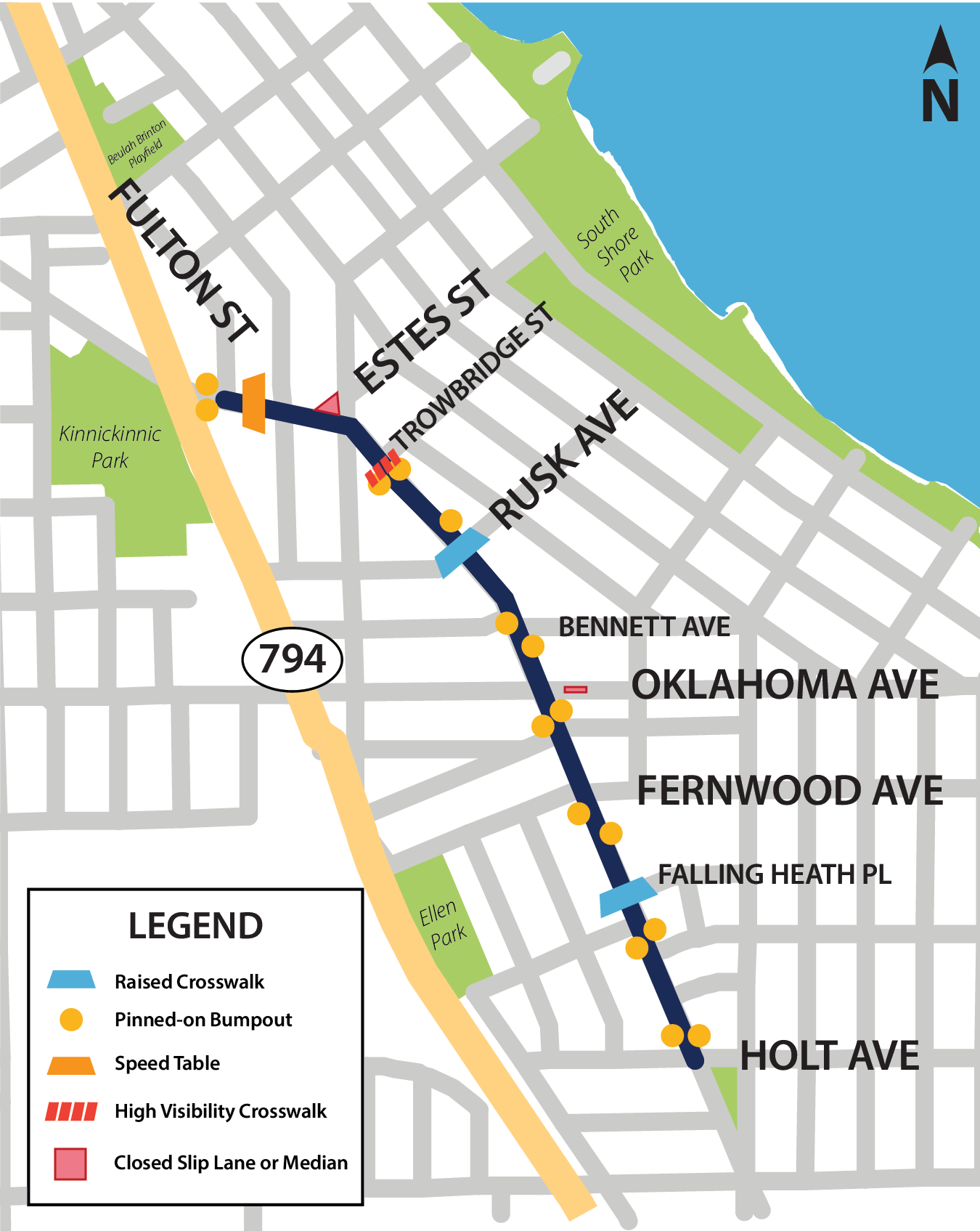
schematic of KK Ave. preliminary Jan 2026 design

Human-Scaled Benefits

A human-scaled street feels intuitive. It communicates, through design, that this is a place where people belong. When lanes are narrower, crossings are shorter, and speeds are moderated, something subtle happens: drivers pay more attention. Pedestrians feel seen. Businesses feel more accessible.

Instead of a corridor that people rush through a place, you get a street people spend time (and money) on.

That matters because comfort determines behavior. If crossing the street feels risky, fewer people will walk. If biking feels stressful, fewer families ride. If a parent doesn’t trust the intersection near a school, they drive instead—adding more congestion to the very street we’re trying to “speed up.”

Human-scaled design reduces that friction.


Economic Benefits

Commercial streets are economic engines. But high speeds and highway-style geometry undermine their productivity.

When vehicles move fast, drivers are less likely to notice storefronts, less likely to stop spontaneously, and more likely to treat the corridor as a pass-through route. Slower, steadier traffic increases visibility and access. It also reduces crash severity, which protects property, and reduces long-term public costs.

Small businesses thrive in environments where:

  • People feel safe walking between shops.
  • Parking maneuvers aren’t stressful.
  • Outdoor seating doesn’t feel exposed to speeding traffic.
  • Families linger instead of hurry.

Across the country, communities that retrofit overly wide corridors into people-centered streets see increases in foot traffic and commercial vitality. It’s about designing for productive land use.


School Zone Safety

Traffic calming becomes especially important near schools. Schools like Bay View’s Fernwood Elementary and Trowbridge School of Great Lake Studies which fall along KK Ave.

Children judge speed and distance differently than adults. They’re smaller, less visible over parked cars, and more likely to act unpredictably. A street that feels “fine” to a confident adult can feel overwhelming and dangerous to a child.

When we redesign streets near schools with raised crossings, tighter corners, and clearer pedestrian space, we send a message: this is a place where kids come first.

Safer school zones don’t just reduce crashes. They:

  • Encourage active transportation—walking and biking.
  • Reduce chaotic drop-off traffic.
  • Build independence for young people.
  • Lower stress for parents.

A community that protects its youngest residents builds trust. This is a lesson we should internalize here in South Milwaukee.


How These Specific Interventions Work

The tools proposed for Kinnickinnic Avenue are proven, practical, and increasingly common. They’re backed by science and best practices. Here’s what each one does:

Raised Crosswalks

A raised crosswalk elevates the crossing to sidewalk level. Drivers must slow as they approach, because the roadway physically rises.

Why they work:

  • Forces lower vehicle speeds at conflict points.
  • Improves pedestrian visibility.
  • Signals clearly that people crossing have priority; ensuring compliance with yielding laws.
  • Enhances accessibility for people using mobility devices by creating a flush crossing surface.

Bumpouts (Curb Extensions)

Bumpouts extend the sidewalk into the parking lane at intersections or mid-block crossings. Shorter crossings mean less time exposed in the street; especially important for seniors and children.

Why they work:

  • Shorten pedestrian crossing distance.
  • Improve sightlines between drivers and pedestrians.
  • Prevent dangerous parking too close to intersections.
  • Calm turning speeds by tightening corner radii.

Speed Tables

Speed tables are long, gently sloped raised sections of roadway. They are flatter and broader than traditional speed humps.

Why they work:

  • Reduce mid-block speeding.
  • Maintain smoother ride quality than abrupt humps.
  • Encourage consistent, steady speeds rather than fast acceleration between signals.
  • Improve comfort for buses and emergency vehicles compared to sharper devices.

High-Visibility Crosswalks

These use bold striping patterns instead of thin parallel lines. Visibility affects driver behavior. Clear markings reduce ambiguity.

Why they work:

  • Increase recognition at greater distances.
  • Improve nighttime and wet-weather visibility.
  • Reinforce pedestrian priority at intersections.

Closing Slip Lanes

Slip lanes allow right-turning drivers to bypass intersections without fully stopping. Closing them reclaims space for pedestrians and simplifies intersections.

Why it works:

  • Eliminates high-speed turning conflicts.
  • Reduces pedestrian exposure to multiple crossing points.
  • Makes intersections easier to navigate for everyone.
  • Reclaims space for public use, landscaping, or bike infrastructure.

Lessons to Learn

  1. Design communicates values. If a street feels like a highway, people will drive it like one.
  2. Speed is the key variable. Lower speeds dramatically reduce crash severity.
  3. Safety and prosperity are linked. Productive corridors depend on comfort and access.
  4. Small changes compound. Together traffic calming interventions reshape driver behavior.

The conversation around Kinnickinnic Avenue isn’t just about Bay View. It’s about what kind of streets we want throughout Milwaukee County, including our South Milwaukee home.

We can build corridors that move cars quickly. Or we can build places where people want to be.

The strongest towns choose the latter and design accordingly.

Leave a comment

Filed under South Milwaukee, Strong Towns South Milwaukee, Viewpoints

Civic Pride Doesn’t Have to be Serious (or Divisive)

Just for fun, I tried to turn civic pride into a game. 😄

As a committed and concerned community member (…and Strong Towns South Milwaukee member), I spend an inordinate amount of time reading, researching and talking about (sometimes) contentious municipal topics—things like infrastructure, budgets, zoning changes, school board proposals, our library, and long-term comprehensive planning. All incredibly important stuff! But sometimes civic life can start to feel… heavy. 

I wanted to remind myself—and our neighbors—that loving this city can be simple, joyful, and even a little silly.

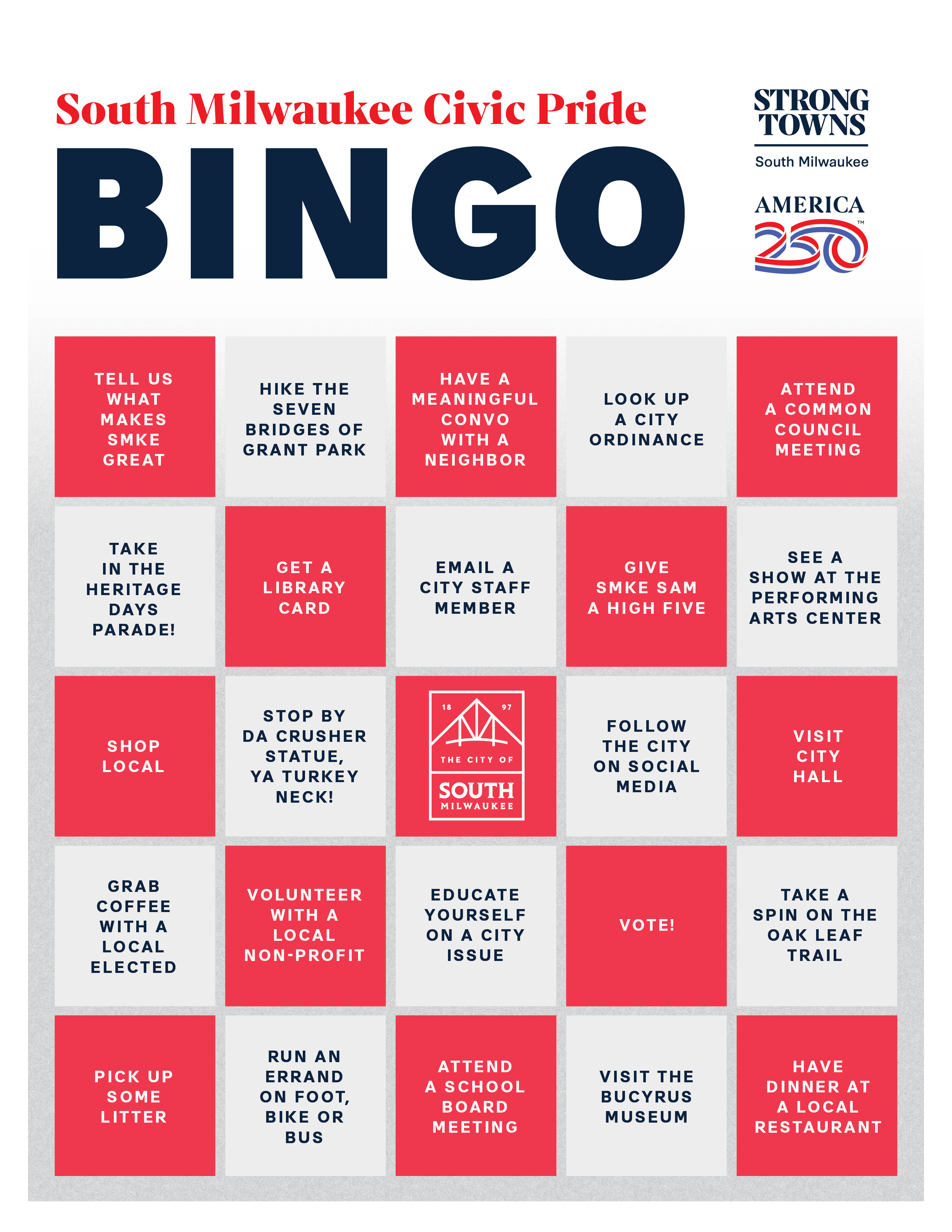
Introducing South Milwaukee Civic Pride Bingo—because civic pride doesn’t have to be serious to be meaningful. No prizes, no pressure, just a fun excuse to explore the city, support local, and appreciate the everyday stuff that makes South Milwaukee feel like home.

A bingo game card

Meetings, debates, campaigns, referendums, arguments on social media, “us vs. them” conversations about politics and priorities. It’s easy for people to feel burned out, disconnected, or like civic engagement is only for policy wonks and activists.

Civic pride doesn’t always have to look like a town hall meeting or a heated comment thread. Sometimes it looks like grabbing a massive cookie from Bakehouse 23, finding a segment of Oak Leaf Trail you never knew existed, attending a community event with friends, or stopping to admire a mural downtown you’ve driven (or biked…) past a hundred times. Those everyday experiences are civic life, too.

I know so many of us really, really love this place. Like, bigger love than South Milwaukee Sam love.

We love South Milwaukee not because it’s perfect, but because it’s ours. Because of the people who show up, the institutions that quietly hold things together, and the small moments that make it feel like home.

That’s the spirit behind Civic Pride Bingo. It’s not about being right, or winning arguments, or proving how engaged you are. It’s about reconnecting with the places and people that make up our shared community, in a way that feels accessible and fun instead of intimidating or divisive.

As we head toward America 250 this July, I hope we’ll have many national conversations about what it means to be part of a country, a democracy, a civic culture. But I think the best place to start is local. Civic pride isn’t built in faraway places—it’s built on our sidewalks, in our library, in our parks, on our beaches,, in our small businesses, and in the conversations we have with our neighbors.

My hope is simple: that this little Bingo game sparks a little more curiosity, a little more joy, and a little more love for South Milwaukee. Because strong towns aren’t just built with plans and policies—they’re built with people who care. And caring, it turns out, doesn’t have to be so serious all the time.

Leave a comment

Filed under South Milwaukee, Viewpoints, Strong Towns South Milwaukee

Real change is coming to 12th Ave. & Milwaukee Ave.

On Tuesday night, the city’s Public Works & Public Property Committee approved six-month, interim safety improvements at one of South Milwaukee’s most challenging intersections—12th Ave and Milwaukee Ave.

The approved changes include removing the first on-street parking space closest to the intersection to improve sightlines, adding a high-visibility stop sign on the northwest corner, and potentially upgrading the stop sign on the southeast corner.

The city engineer designed the plan to expand the vision triangles to Manual on Uniform Traffic Control Devices (MUTCD) standards, exceeding what current South Milwaukee code requires. Both the Police Chief and officers shared that, based on experience, high traffic volumes and poor visibility are major contributors to collisions here.

We’re encouraged to see the city take practical, low-cost action instead of waiting years for a full reconstruction or a $20,000 traffic study. This is exactly the kind of “try something, measure it, improve it” approach we support.

So what does success look like for this intervention?

So far, the conversation has focused almost entirely on drivers. From a Strong Towns perspective, success should also be measured by how this intersection works for everyone.

That means looking for fewer crashes and near-misses, lower vehicle speeds approaching the intersection, and better visibility for all users. It also means more comfortable crossing for pedestrians, greater predictability for people biking, and, just as importantly, fewer residents saying that “this intersection feels bad.”

In other words, not just does traffic move — but does this place feel safer to be in?

We applaud the city for taking this first step. Now let’s use this pilot to collect data, listen to residents, and keep moving toward a safer South Milwaukee.

Leave a comment

Filed under Strong Towns South Milwaukee