

I am proud to offer this space to my daughter, Shelby, who will be writing series of book reviews of banned books. Get in some good trouble, kid!
John Green’s first novel Looking for Alaska appeared on the American Library Association’s list of the top 10 most challenged books in 2012, 2013, 2015, and 2016, as it was claimed to be sexually explicit. In 2022 alone, this novel was challenged 50 times. This book is often labeled “poronography” by those who wish to ban it, much to the dismay of Green.
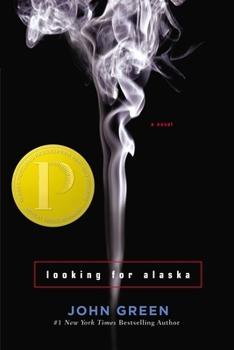
Looking for Alaska follows protagonist Miles “Pudge” Halter, who transfers to a boarding school in Culver Creek in search of his own “Great Perhaps.” At school, Pudge becomes close with his roommate Chip Martin, nicknamed the Colonel, and they form their own type of breakfast club with the only Japanese student, Takumi, Romanian immigrant Lara, and the unpredictable Alaska Young. Throughout the book, Pudge and Alaska explore what it means to escape the labyrinth of life, discovering themes of grief, economic class division, adolescent drinking, and friendship.
The Colonel acts as the ringleader of their group, planning strategies for all of their pranks. The interesting aspects of his character are shown through his poor background but undying loyalty to his beloved mother. When asked about the best day of his life, Colonel looks towards the future instead, describing his perfect day as the day when he buys his mother a new house so she can move out of their trailer, finally finding a way to thank her for all she’s done for him. When Alaska’s unexpected death comes later in the novel, Colonel despises any students who he believes don’t have the right to grieve because they didn’t know Alaska well enough. He’s the main one who tries to find an explanation for her death, and he heavily resists the idea of her committing suicide when it first comes up.
With economic divides at all time highs in our country, the class divide at Culver Creek feels awfully real, as the richer students obviously have a lot more pull than the poor ones. As a student in an impoverished district, this poor background is a reality for many of my peers. There’s a belief from upper class people that being poor is horrendously sad and debilitating, but Colonel is the perfect example of making the best out of your situation. Throughout the book, Colonel proves that your background does not have to define you, which is a thoughtful sentiment that still holds true today, two decades after the book is set.
This book has been most often challenged for its “pornography,” though, as someone who just finished the book, its intimate scenes are anything but. There’s only one real sex scene in the novel, and it’s described by John Green as “awkward, unfun, disastrous, and wholly unerotic.” This is followed directly by a scene with no physical intimacy but more raw emotion than we’ve seen so far. Green uses this contrast to actually advise against teenage physical intimacy, as it ends up feeling rather emotionless. He instead points out that you can have lovely tender moments without skin on skin contact.
According to the CDC, over half of U.S. teens have had sexual intercourse by age 18 in the year 2017. Underage sex is something that has always existed, and the numbers are only rising. One of the downfalls to our increasingly digital world is the fact that access to pornography is at the fingerprints of young adults. Instead of shaming and degrading the idea of underage sex, we should focus more on increased access to inclusive sex education. It’s proven that comprehensive sex education programs actually reduce the rates of sexual activity as a whole. In Looking for Alaska, Green uses non arousing almost medical terminology in any intimate scenes, treating these parts of the novel as a form of sex ed. Green, along with many other YA authors, argues that books that include teen romance and intimacy should not be labeled as pornography.
When Alaska decides to drive drunk and ultimately dies because of it, it’s arguably the most impactful moment of the book. After the accident, Pudge grapples with the fact that he might’ve enabled this by letting Alaska get behind the wheel, feeling a tremendous amount of guilt in the midst of his grieving process. Colonel and Takumi blame themselves as well. It’s pointed out later that this accident may have instead been suicide, but it’s eventually left up to the reader to decide.
This is the part of the book that struck me the most, as I noticed the warning signs written in the pages but I couldn’t do anything about it. That feeling of complete helplessness is probably similar to how Pudge and the others felt when they received the news of Alaska’s tragic death. As stated by the Childhood Hospital of Philadelphia, 19% of alcohol-impaired drivers involved in fatal car crashes were between 15 and 20 years old in the year 2022. Driving under the influence of alcohol or maurijana isn’t nearly as rare as it should be for teens.
There’s a thought that things like that don’t happen in South Milwaukee, but I can strongly say that I know of far too many cases of underage driving under the influence in the past year alone. I’ve even had to deal with some of these issues firsthand. After reading this, I’m even more inclined to raise my voice when one of my peers may want to drive under the influence. What happened to Alaska is the worst case scenario, but it’s a scenario that happens all too often. Whether Alaska really was too drunk to notice her mistake or she drove into the cop cruiser on purpose, she likely wouldn’t have done the same thing sober. Censoring this cautionary tale of drinking and driving is a disservice to anyone my age, as fatalities are far more common if we aren’t educated on the dangers of driving under the influence.
This novel is also one that heavily questions the idea of religion and the afterlife. It’s a book that criticizes Buddishm, Christianity, and atheism alike, not picking a side but instead stating that all can be true. Just before Alaska’s death, Pudge explores the idea of the afterlife for himself. “People, I thought, wanted security. They couldn’t bear the idea of death being a big black nothing, couldn’t bear the thought of their loved ones not existing, and couldn’t even imagine themselves not existing. I finally decided that people believed in an afterlife because they couldn’t bear not to.” I understand why Christian Conservatives choose to challenge this book in particular, since it happens to criticize the very religion they follow.
As Alaska Young grapples with her obvious mental illness and childhood trauma, she asks a question that I feel the need to ask my friends on occasion: “Don’t you know who you love, Pudge? You love the girl who makes you laugh and shows you porn and drinks wine with you. You don’t love the crazy, sullen bitch.” I think it’s unfortunate how true this is for myself and so many others. I often wonder if people would love me the same if I was always in the midst of an anxious episode, if I wasn’t kind and upbeat all the time.
Before this, she shows a strong aversion to wanting to go home for the holidays. “I’m scared of ghosts, Pudge. And home is full of them.” Alaska’s fear of going home is due to her trauma around her mother dying in front of her and her father blaming her for it. This self hatred is an eventual cause for her death, whether it was suicide or accidental. When Alaska is asked about her favorite day ever, she recalls the day before her mothers death, when they went to the zoo together. Alaska’s trauma and mental illness is what makes her so relatable to readers.
Most YA books published around 2005 were sci-fi and fantasy, with unrelatable characters, which is what makes Looking for Alaska all the more powerful. John Green weaves his story with complex friendships, class division, teen intimacy, and driving under the influence all in one. When describing why he wrote the book, Green says, “I wanted to write about sexuality and substance abuse because it felt true to the characters. When you’re a teenager, you’re doing all kinds of important things for the first time, and in writing Alaska I wanted to deromanticize some of those firsts.”
Green’s debut novel is a powerful tale that shows a group of teenagers constantly seeking what makes them feel alive, giving up their safety in order to do so. I believe that Pudge’s final essay sums this up perfectly. “Those awful things are survivable, because we are as indestructible as we believe ourselves to be. When adults say, “Teenagers think they are invincible” with that sly, stupid smile on their faces, they don’t know how right they are. We need never be hopeless, because we can never be irreparably broken. We think that we are invincible because we are. We cannot be born, and we cannot die. Like all energy, we can only change shapes and sizes and manifestations. They forget that when they get old. They get scared of losing and failing. But that part of us greater than the sum of our parts cannot begin and cannot end, and so it cannot fail.”

 South Milwaukee Blog
Shelby, I remember Tropic of Capricorn by Henry Miller as a banned book when I was in school. Because it was banned, I searched and somehow obtained a copy. I tried to read it, but it was over my head. I was 10 at the time. Now I am challenged to find a copy to read as an adult.
Two books that had profound effect on me in high school were Black Like Me (banned in much of the south for obvious reasons) and Yes I Can, the autobiography of Sammy Davis Jr describing how he dealt with racism as a youth, as a soldier in WWII, and as an entertainer.
I am going to use your reviews as a ‘summer reading list’.
THANK YOU!!!
Erik, please pass this comment to Shelby’s review of John Green’s *Looking for Alaska *on to her. I’d love to leave it on your blog, but still no can do. Thanks!
Jerrianne
Jerrianne Hayslett, Author Valiant Vel: Vel Phillips and the Fight for Fairness and Equality Wisconsin Historical Society Press, February 18, 2025